Clermont is unusual for Florida: it sits on the northern end of the Lake Wales Ridge, so the city rolls up and down between the water of the Clermont Chain of Lakes and the hilltop subdivisions built during the rapid growth that followed the year 2000. That terrain changes how water damage happens. Rain that falls on a hillside street does not soak in evenly; it runs downhill and gathers against the low side of a house, along a foundation, or in the yards nearest Lake Minneola, Lake Minnehaha and Lake Louisa. Water Damage Florida provides water damage restoration in Clermont around the clock, whether the water came from the sky, the lake, or a pipe inside the wall.
We serve the entire city, from the downtown residential historic district near Waterfront Park to the large 55-plus golf communities such as Kings Ridge, Summit Greens and Legends, and the newer subdivisions along the highways. If you have water where it should not be, call (888) 435-4769 now and we will tell you what to do while a crew is on the way.
Emergency Water Damage Response Across Clermont
A typical emergency call from Clermont involves a home that was built well after 2000. That surprises some owners, but newer construction has its own weak points: flexible supply lines that fail at the crimp, water heaters in interior closets rather than garages, and dishwashers and refrigerators plumbed into the middle of an open floor plan where a leak spreads across the whole kitchen and living room before anyone notices. In the 55-plus communities the home may also be empty for part of the year, which turns a small drip into a large loss.
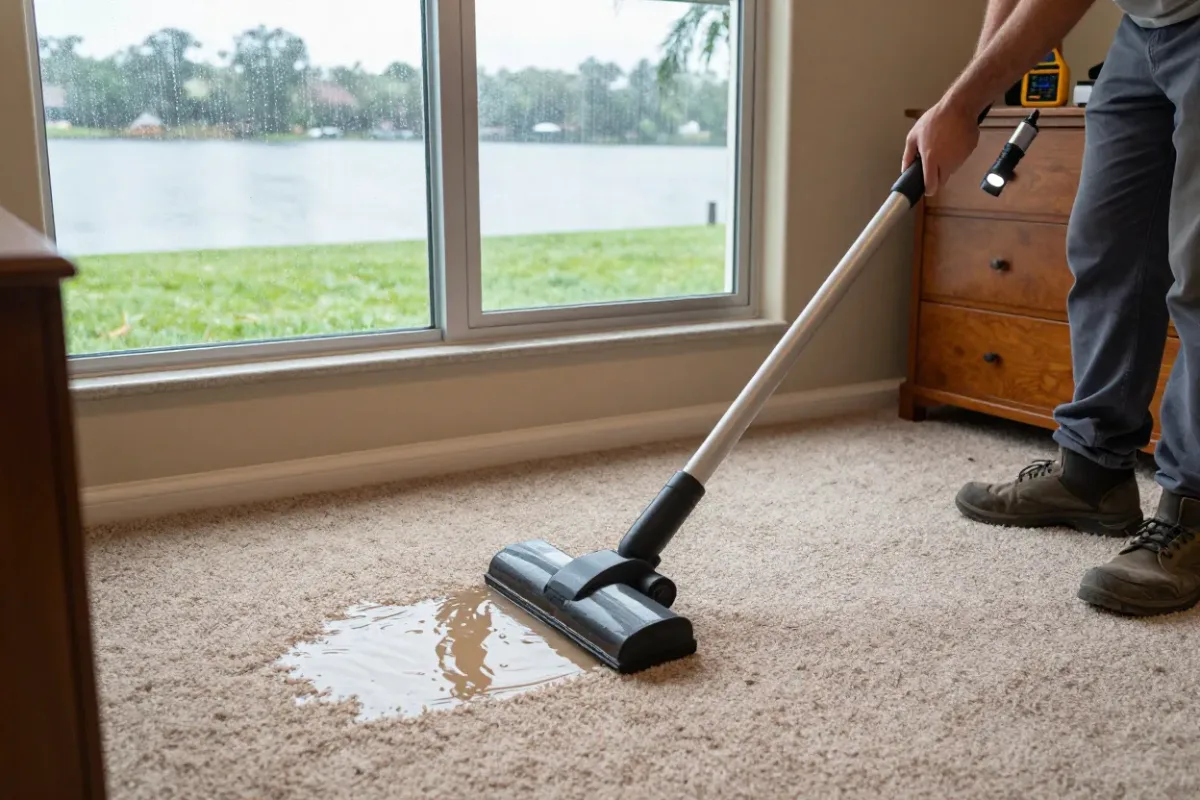
We respond with extraction equipment sized to the job, from portable units for a single bathroom to truck-mounted extractors for a whole floor, and we begin drying on the same visit. Every wet area is measured and photographed before we set equipment, so the record for your insurance claim starts on day one. If the water came from outside during a storm, we treat it as contaminated and adjust the plan. Our emergency water damage page describes what to expect from the first call.
Restoration for Golf Community Villas, New Subdivisions and Historic Homes
Clermont's housing splits into three broad types, and each dries differently. Newer subdivision homes and villas in Kings Ridge, Summit Greens and Legends are mostly block-and-stucco on slab with tile or luxury vinyl plank floors, drywall interiors and a lot of built-in cabinetry. In those, the slab holds water under the flooring and the drywall wicks it upward, so we lift flooring and open walls at the base to get air to the wet surfaces. In the downtown Clermont residential historic district, older wood-framed homes with raised floors and plaster need a gentler approach that saves original material where readings allow.
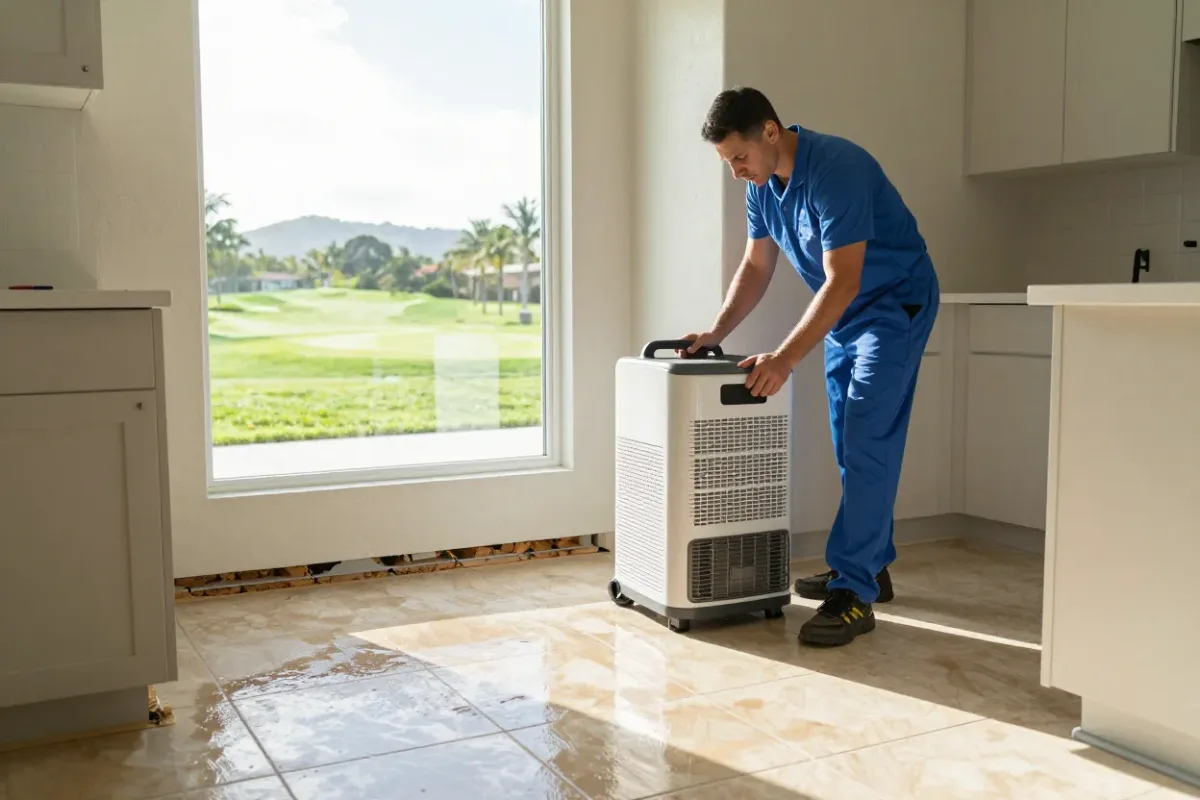
In every case the goal is verified dryness, not a dry-looking surface. We run dehumidifiers and air movers inside the closed home, check moisture in each material daily, and keep equipment in place until readings reach the dry standard. Cleaning and antimicrobial treatment follow when the water was contaminated, and only then do we schedule repair. See our water damage restoration service overview for the full picture.
Flood Cleanup on the Low Side of the Ridge
Flood risk in Clermont concentrates where the hills end. The Chain of Lakes, linked by the Palatlakaha River system, collects runoff from the ridge, so the low ground around Lake Minneola, Lake Minnehaha, Lake Louisa, Lake Hiawatha and Johns Lake is where water gathers when the summer rains from June through September come hard. Homes at the bottom of a sloping street can also take runoff through a garage or a sliding door even when the lake itself is nowhere near. Clermont has not had a verified storm-flooding event of its own in the recent hurricane seasons, but it sits in the same inland belt of Central Florida that recent storms have crossed, and the terrain makes localized flooding likely in an extreme rain.
Runoff and lake water bring silt, fertilizer and debris into a home, so flood cleanup means removing rather than drying the porous materials it touched: carpet and pad, the lower drywall, insulation and cabinet bases. Hard surfaces are cleaned and disinfected, air filtration runs during the work, and drying proceeds once the contamination is out. Our statewide flood restoration page explains the full cleanup sequence.
Repairing Clermont Homes After Water Damage
Repair work in Clermont often means matching finishes in a home that is still fairly new: replacing sections of luxury vinyl plank or tile, rebuilding cabinet toe-kicks and vanity bases, hanging and finishing drywall, reinstalling baseboards and repainting so the repaired wall blends with the rest of the open plan. In villas with shared walls we also repair the neighbor's side when moisture crossed the party wall.
For homes in the historic district, repair is about preservation: drying original wood floors in place when the readings allow, replacing plaster only where it failed, and matching trim profiles. Whatever the home, the repair scope follows the moisture map and photos from mitigation so you and your adjuster can see exactly what the water affected.
Mold Removal in Clermont
Homes in Clermont's 55-plus communities are often closed up for weeks at a time, and a closed house with the air conditioning set warm is the condition mold likes best. We find growth most often on the back of drywall behind a slow-leaking water heater closet, under vinyl plank flooring that was mopped after a leak but never dried underneath, in the base of kitchen cabinets, and around window frames on the weather side of hillside homes.
Our mold cleanup starts with the moisture source, because growth returns if the wall stays damp. We contain the work area with sheeting and negative air, remove and bag the affected porous materials, HEPA-vacuum and clean the surfaces that remain, and dry the cavity before it is closed. Read more on our mold remediation page, and if you are returning to a seasonal home that had a leak while you were away, our note on hidden mold after water damage is worth a few minutes.
What Causes Water Damage in Clermont Homes
The calls we take in Clermont reflect a city of mostly newer homes on hilly ground, with a wet season that runs June through September and a large number of residents who travel. The usual sources are:
- Runoff from sloping streets and lots pooling against the downhill side of a home
- Braided supply lines and toilet connectors failing in homes that are empty for part of the year
- Water heaters in interior closets leaking onto carpet and drywall before anyone notices
- Air conditioning condensate overflow during long stretches of continuous cooling
- Dishwasher and refrigerator line leaks spreading across open-plan tile and plank floors
- Roof and window intrusion in wind-driven summer thunderstorms
- Lake and canal water rising into low lots around the Clermont Chain of Lakes
- Irrigation and exterior hose bib breaks saturating the soil next to the foundation
The Restoration Sequence We Follow
Whether the job is a single villa bathroom or a whole first floor, our Clermont crews follow these eight steps in order so that nothing gets closed up wet.
- Inspect and map the moistureWe locate the source, judge whether the water is clean or contaminated, and use meters and thermal imaging to find how far it traveled under flooring and into the wall cavities.
- Pull the standing waterExtraction wands and pumps remove bulk water from tile, plank, carpet and slab; the sooner this happens, the more flooring can be kept.
- Take out unsalvageable materialsSwollen baseboard, wet drywall, soaked pad and cabinet bases that cannot be dried are removed and bagged to open the wet areas to air.
- Dry with monitored equipmentDehumidifiers and air movers run in the closed home with the air conditioning on, and we log readings each day until the slab, framing and drywall meet their dry targets.
- Clean and sanitizeSurfaces that contacted runoff or lake water are cleaned and treated, and air scrubbers run while the work is in progress.
- Assemble the documentationDaily moisture logs, photos and a written scope are compiled so you and your insurance adjuster have the same record.
- Repair and refinishFlooring, drywall, cabinetry, trim and paint are replaced or restored so the repaired area matches the rest of the home.
- Final moisture checkWe take a closing set of readings and walk the home with you to confirm everything is dry and finished.
Clermont Neighborhoods and Communities We Serve
Our crews cover all of Clermont, from the streets downtown near Lake Minneola and Waterfront Park to the gated golf communities and the subdivisions along the highways. The terrain matters: a home at the bottom of a hillside street and a villa on the ridge face different risks, and we plan the response for each.
Areas of Clermont
- Downtown Clermont / Clermont Residential Historic District
- Kings Ridge
- Summit Greens
- Legends
- Lost Lake
- Greater Hills
- Greater Pines
- Heritage Hills
- Indian Hills
- Spring Valley
- Postal Colony
- Crescent Bay
- Hartwood Landing
Nearby Communities
South Lake County and the west Orange County communities next door share the same hills and lakes, and our Clermont crews serve them as well. Several have their own local pages:
What to Do Before We Arrive
A few careful actions in the first hour protect the home and your claim. Skip anything that puts you in contact with water near electricity.
- Close the supplyTurn off the fixture valve or the main shutoff, which in most Clermont subdivisions is at the front of the house near the hose bib or at the meter box by the street.
- Stay out of rooms where water meets powerIf outlets, cords or appliances are in the water, do not enter. Cut power at the breaker only if the panel is dry and you can reach it on dry footing.
- Do not touch runoff or lake waterWater that came in from the yard or the lake carries contaminants. Keep family and pets out and leave the cleanup to the crew.
- Raise what you canMove electronics, rugs and boxes to a dry room and put foil or plastic under furniture legs that stay.
- Record the scenePhotograph the source, the extent of the water and each affected room before anything is moved.
- Keep the house cooled and closedLeave the air conditioning running and windows shut. Cool, dry air slows microbial growth while you wait.
- Call Water Damage FloridaDial (888) 435-4769 and tell us the source, how long the water has been there and whether the home is occupied or seasonal.
If a storm is involved, our first 24 hours after a flood guide covers what to do when the water is still rising.
Clermont Water Damage FAQs
Our home in Kings Ridge is empty every summer. What happens if a pipe fails while we are away?
The water runs until someone finds it, which is why seasonal homes see some of the worst losses. Before you leave, shut the main valve, turn off the water heater, and ask a neighbor or property watcher to walk through periodically. If you return to a wet house, call us before you start cleaning; the drywall and flooring may need to come out, and documentation matters for the claim.
Rain runs down our street and pools against the garage. Is that covered by water damage restoration?
Yes, we handle runoff intrusion regularly in Clermont because of the hills. We extract the water, remove what it soaked, dry the garage and adjoining rooms, and document it. Whether your policy covers surface water is a question for your carrier, and our records help you answer it.
Can luxury vinyl plank flooring be saved after a leak?
Sometimes. Plank flooring is water-resistant on top but traps moisture beneath, so the deciding factor is how long the slab under it has been wet. Caught quickly, it can often be lifted, dried and relaid. Left for days, the slab and adhesive are usually too wet and the flooring is replaced after drying.
Does a lakefront home on Lake Minneola need anything different?
Lake water is treated as contaminated, so porous materials it reached are removed rather than dried, and we watch for water re-entering from saturated ground during drying. Docks, seawalls and boathouses are outside our scope, but the home itself is handled like any other contaminated-water loss.
How do you handle a historic home downtown?
Carefully. Older wood-framed homes with raised floors and plaster can often be dried in place if we start early, and we favor saving original material whenever moisture readings allow. Where plaster or flooring has failed we replace only that section and match the surrounding finish.
Will the drying equipment be loud, and how long does it stay?
Air movers and dehumidifiers are noticeable but tolerable, similar to a running window unit. Typical drying runs a few days for a small clean-water loss and longer when a slab or a whole floor is wet. We remove the equipment when the moisture readings reach the dry standard for each material.