Ocala's water problems come from above and below rather than from the sea. The city sits on gently rolling upland in Marion County, well away from any coast, surrounded by horse farms, the Ocala National Forest and some of the largest spring systems in the world at Silver Springs and Rainbow Springs. Those springs, the Ocklawaha River and the region's karst geology reflect a high water table beneath ground that otherwise drains well. Above ground, the risks are heavy tropical rainfall and wind-driven tree damage: Hurricane Milton in 2024 dropped several inches of rain on the county, with the heaviest totals just south of the city, and uprooted trees destroyed homes in the Ocala area.
Water Damage Florida provides 24/7 water damage restoration in Ocala, serving everything from Queen Anne and bungalow-era houses in the Ocala Historic District to the later subdivisions and retirement communities spreading across the city's edges. Call (888) 435-4769 whenever you find water where it should not be, and we will tell you what to do first and dispatch a crew.
Emergency Water Damage Service in Ocala
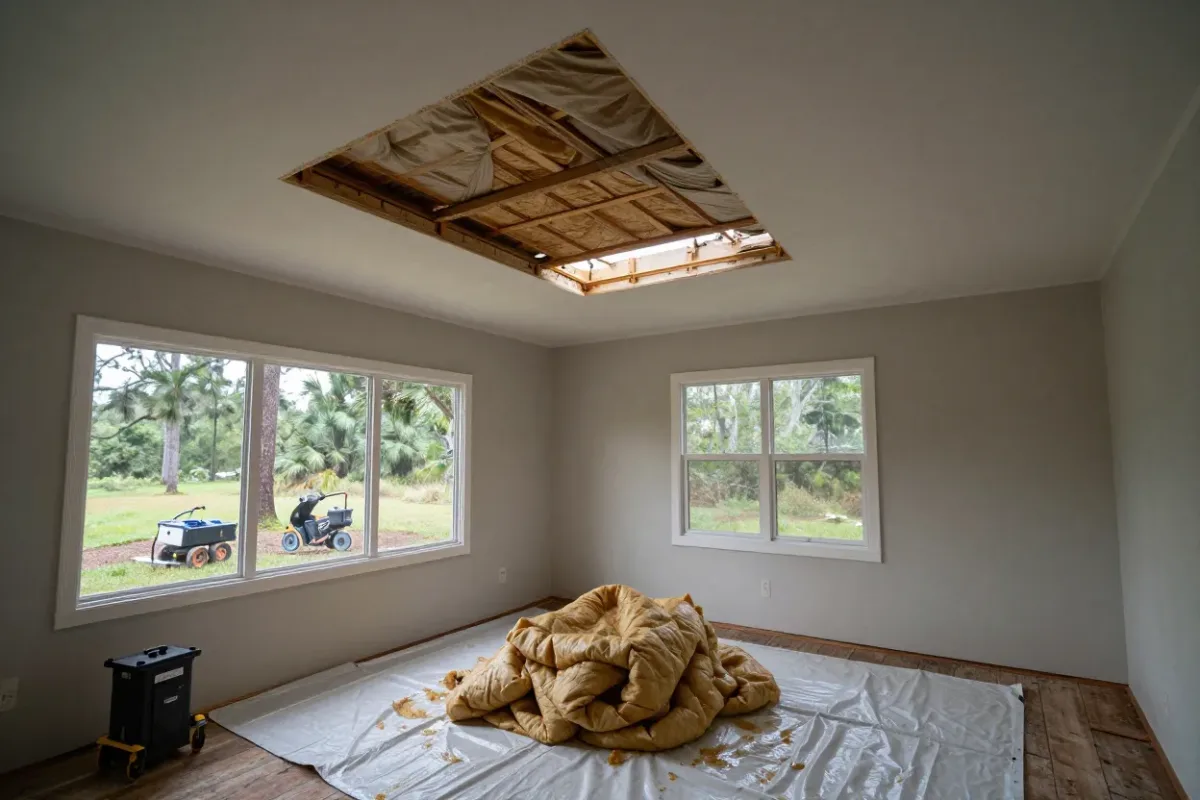
In Ocala the emergency that most often brings us out is a roof opened by a tree. The city's oaks and pines are part of its character, and when saturated soil and high winds combine, limbs and whole trunks come down onto roofs, letting rain into attics, ceilings and walls. The other frequent emergencies are indoor: water heaters giving out in retirement villas, supply lines failing in homes that sit empty during summer travel, and slab leaks in single-story houses that go unnoticed until flooring lifts.
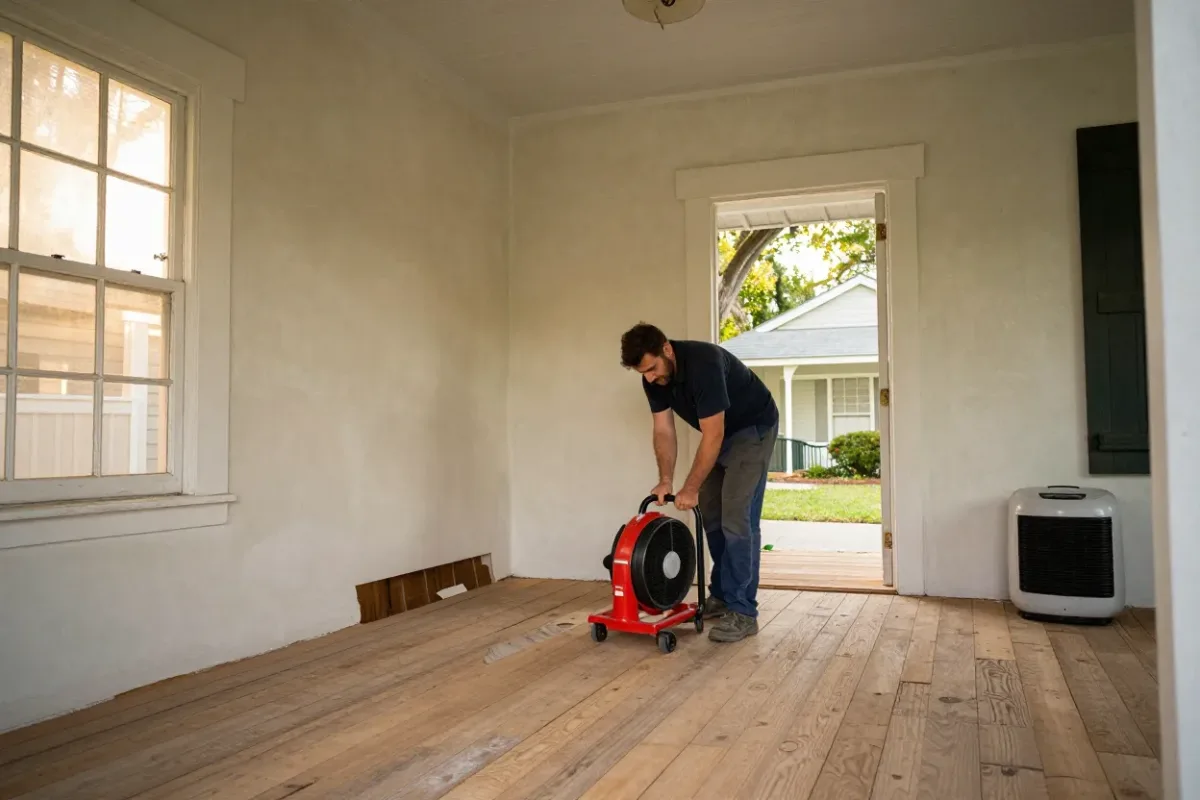
Our crews arrive to extract water, remove wet insulation and sagging ceiling drywall where a roof has failed, protect the opening from further rain, and start air movers and dehumidifiers on the first visit. We document moisture readings and photographs from the outset so your insurance claim has a clear starting record. For a description of the first-response process statewide, see our emergency water damage page.
Restoration for Victorian Homes, Bungalows and New Subdivisions
Ocala's housing spans well over a century. The Historic District east of downtown holds a couple hundred homes built between the 1880s and 1930s, from Queen Anne Revival houses on the oldest streets to Florida-boom-era bungalows, with wood framing, plaster and original floors that respond well to patient drying and badly to hasty demolition. The rest of the city is dominated by later single-family subdivisions and retirement communities, where slab floors, drywall and carpet call for fast extraction and straightforward controlled drying.
We map every wet material with meters and thermal imaging, dry in place what the readings say can be saved, and remove what cannot. Drying runs in a closed home with dehumidifiers sized to the space and is logged until materials reach their dry standard. Only then do we clean, treat where the water category calls for it, and rebuild. Our water damage restoration page covers each phase in more depth.
Flood Cleanup After Tropical Rain
Without a coastline, Ocala's flooding is rain-driven. Hurricane Milton in 2024 and Hurricane Debby the same year both brought heavy rain to Marion County, and the county was included in disaster declarations for Hurricane Irma in 2017. When a tropical system stalls or trains over the area, water collects in low yards, at the bottom of sloped lots, in garages and in ground-floor rooms, and the high water table beneath the springs country means it can be slow to soak away.
Water that has crossed a yard or street is treated as contaminated even if it looks clear. We remove the porous materials it soaked, clean and disinfect hard surfaces, and run air filtration while the structure dries. If a storm has just passed and you are looking at wet floors, read our first 24 hours after a flood guide and call us; the flood restoration page explains what happens after that.
Repairing the Damage Once Drying Is Done
Repair in Ocala often starts at the top of the house. After tree damage, that means new ceiling drywall and insulation under a repaired roof, repainting, and sometimes replacing wall sections where water ran down inside the framing. At floor level it means replacing swollen laminate, re-laying tile that lifted over a slab leak, rebuilding cabinet bases and replacing baseboards. In Historic District homes we save and refinish original flooring and match trim profiles rather than swapping in modern stock.
The repair scope is drawn from the moisture logs and photos gathered during mitigation, which gives your adjuster a clean separation between storm or leak damage and ordinary wear. For retirement community homes, we coordinate with the association where rules on contractors and work hours apply.
Mold Removal After Roof Leaks and Storms
Mold follows water that was not fully dried, and in Ocala the usual places are attic insulation and ceiling cavities under a roof that leaked after a storm, the back of cabinets over a slow supply-line drip, crawlspaces beneath older raised homes, and the lower walls of a garage that took storm runoff. Summer humidity slows natural drying and lets growth establish before it is visible.
We correct the moisture source first, then contain the affected area, run HEPA air filtration, remove and bag contaminated porous materials, clean remaining surfaces and dry the space completely before rebuilding. Details of the method are on our mold remediation page; if you have a wall or ceiling that was wet once and then painted, read where hidden mold forms after water damage first.
Why Ocala Homes Get Water Damage
An inland city of old oaks, spring-fed karst ground and a large share of older and retirement housing has a particular pattern of losses. The causes we see most often in Ocala are:
- Uprooted trees and heavy limbs opening roofs during tropical storms
- Roof and flashing leaks under years of leaf and pine-needle buildup
- Water heater and supply line failures in single-story retirement homes
- Slab leaks that go unnoticed under tile and laminate floors
- Heavy rainfall ponding in low lots and garages during stalled systems
- Aging plumbing in Historic District houses built before the 1930s
- Air conditioning condensate overflows in homes left closed during summer travel
- Washing machine and dishwasher line failures
Our Restoration Sequence
Each Ocala job moves through the same eight steps in the same order. Skipping ahead is how a ceiling gets closed up over wet framing.
- Inspection and source identificationWe find where the water came from, judge whether it is clean or contaminated, and map how far it spread through ceilings, walls, floors and attic spaces.
- Water removalStanding water is extracted with portable or truck-mounted units, and pumps clear flooded garages and low rooms.
- Removing unsalvageable materialsWet attic insulation, sagging ceiling drywall, soaked carpet pad and swollen cabinetry are removed and bagged; original wood and plaster in historic homes are kept wherever drying can save them.
- Drying and dehumidificationAir movers and dehumidifiers run in a closed house, with readings logged on every visit until framing, subfloor and drywall are back at their dry standard.
- CleaningSurfaces touched by contaminated water are cleaned and treated, with air filtration running throughout.
- DocumentationPhotos, moisture logs and a written scope are gathered for you and your insurance carrier.
- RepairCeilings, drywall, insulation, trim, flooring and paint are restored to match the rest of the house.
- Final checkA final round of moisture readings and a walkthrough confirm the home is dry and the work is complete.
Ocala Areas We Serve
We respond throughout the city and the surrounding county, from the Historic District and downtown to the subdivisions and retirement communities in every quadrant of Ocala.
Ocala Neighborhoods
- Downtown Ocala
- Ocala Historic District
- Southeast Ocala
- Southwest Ocala
- Northwest Ocala
- Northeast Ocala
Nearby Communities
Our crews cover Marion County and the neighboring communities in every direction. Several have their own pages with local detail:
First Steps After Finding Water Damage
A calm first hour saves flooring, drywall and belongings. These steps are safe for most homeowners.
- Close the water supplyIf the source is plumbing, shut the fixture valve or the main. For a roof leak, put buckets under the drip and move belongings out of the way.
- Stay clear of water around electrical equipmentDo not step into a wet room where outlets, cords, appliances or the panel could be in the water. Turn off power to the area only from a dry, reachable panel.
- Keep out of storm runoffWater that has come in from outside is contaminated; keep family and pets away and leave it for us.
- Do not go under a sagging ceilingCeiling drywall holding water can fall. Stay out of the room until we can drain and remove it safely.
- Move what you canLift rugs and electronics, and put foil or blocks under furniture legs on wet floors.
- Take photographsCapture the source, the water level and each affected room before moving anything.
- Call for helpReach Water Damage Florida at (888) 435-4769 with the source, the time it has been wet and the size of the affected area.
Ocala Water Damage FAQs
A tree fell on my roof during a storm and rain came in. What do you do first?
We protect the opening from further rain, remove wet insulation and any ceiling drywall that is holding water, extract what has reached the floor, and set up drying. Roof repair itself is coordinated separately, but we make sure the interior is dried and documented so nothing is closed up wet.
Do you work in Ocala's retirement communities?
Yes. We follow each community's rules on contractor access and work hours, coordinate with the association where required, and provide the documentation both you and the community need.
Can the original wood floors in my Historic District house be saved?
Often, if drying starts soon after the loss. We meter the flooring and framing, dry them under controlled conditions, and refinish rather than replace whenever the readings allow.
How do I know if I have a slab leak?
Warm spots on the floor, lifting tile or laminate, a water bill that rises for no reason and damp baseboards along interior walls are common signs. We can confirm moisture in the slab and surrounding materials during inspection so the leak can be located and repaired.
Is rainwater that flooded my garage safe to clean up myself?
We advise against it. Water that has crossed a yard or street picks up contaminants, so we treat it as such: porous materials it soaked are removed and hard surfaces are disinfected.
Which communities around Ocala do you serve?
We serve all of Marion County, including Silver Springs, Silver Springs Shores, Belleview, Dunnellon, Marion Oaks and On Top of the World, as well as The Villages, Leesburg, Mount Dora and Gainesville, and the rest of Florida through our statewide service areas.