Sebastian is the most populous city in Indian River County, spread across the flat ground where the St. Sebastian River meets the Indian River Lagoon, across the water from Pelican Island National Wildlife Refuge. It grew from a small fishing village into a large residential community platted by the General Development Corporation, and today most of it is single-family homes on GDC lots occupied by a notably older, retirement-heavy population. Water Damage Florida provides 24/7 water damage restoration in Sebastian, from a burst pipe in a single-story home to rain flooding that follows the city's canals and swales right up to the door.
Our crews cover every part of the city, arrive with extraction and drying equipment, and start documenting moisture readings on the first visit. If water is coming into your home now, call (888) 435-4769 and we will tell you what to do while a team is on the way.
Emergency Water Damage Response in Sebastian
The emergencies we see in Sebastian follow the city's layout. Its street and drainage network was laid out by GDC in the late 1950s for roughly fifteen thousand home sites and relies on canals, ditches and swales that discharge to the St. Sebastian River and then the lagoon. The city itself acknowledges the system was built to 1950s standards and lacks modern storage, so when a storm dumps more than the swales can carry, water rises in yards, across driveways and into garages and low slab homes. Hurricane Irma in 2017 brought more than a foot of rain to Indian River County and left most of it without power, and that combination, rising water and no electricity, is the kind of emergency we plan for.
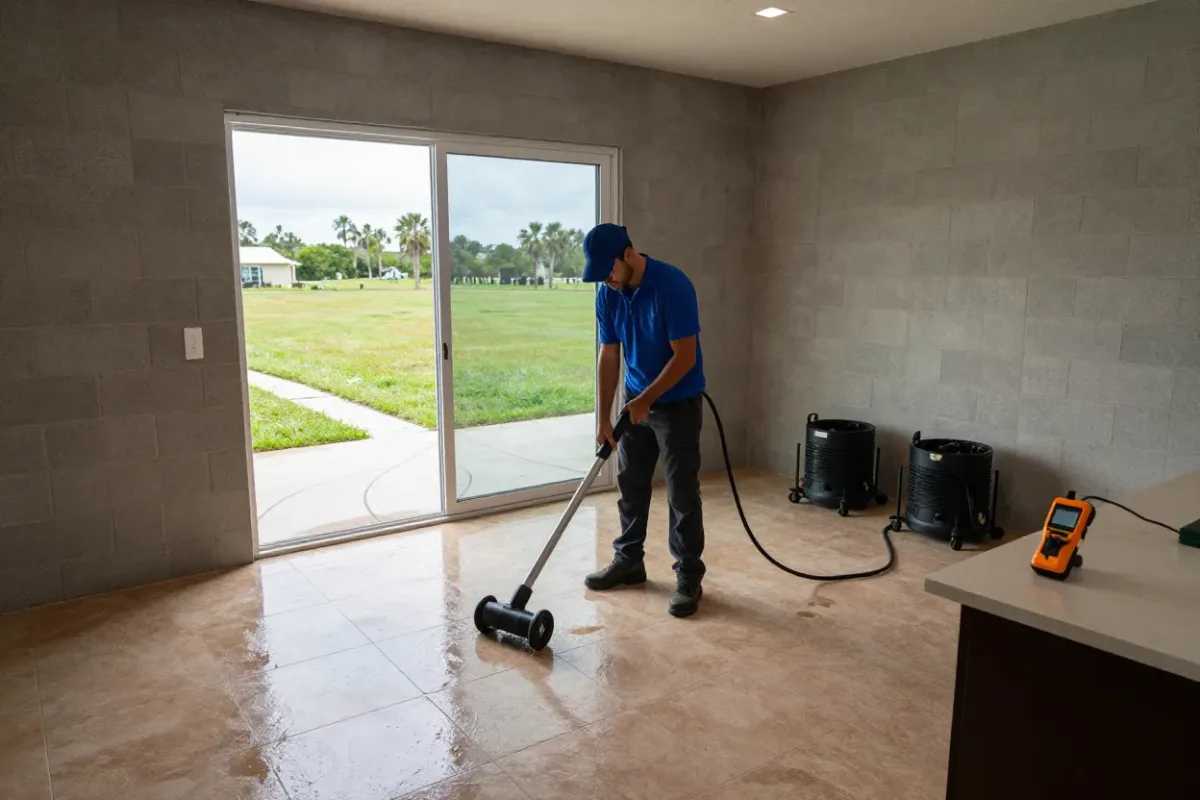
We arrive with pumps, extraction equipment, air movers, dehumidifiers and generator power so drying can begin regardless of the grid. The first visit is about stopping the source, removing standing water, cutting out materials that are already lost, and getting air moving before moisture climbs further into the walls. Photos and moisture readings taken on arrival become the foundation of your insurance documentation. Our emergency water damage page explains how those first hours work.
Restoring GDC-Era Single-Family Homes
Most Sebastian homes are single-story houses on slab, built over several waves of development on the original GDC plat. That construction is straightforward to restore when the response is quick: concrete block and slab shrug off water, and the vulnerable materials are the drywall, baseboards, flooring, cabinets and insulation in front of them. We measure how far moisture has traveled with meters and thermal imaging, remove only what cannot be saved, and dry the rest in place.
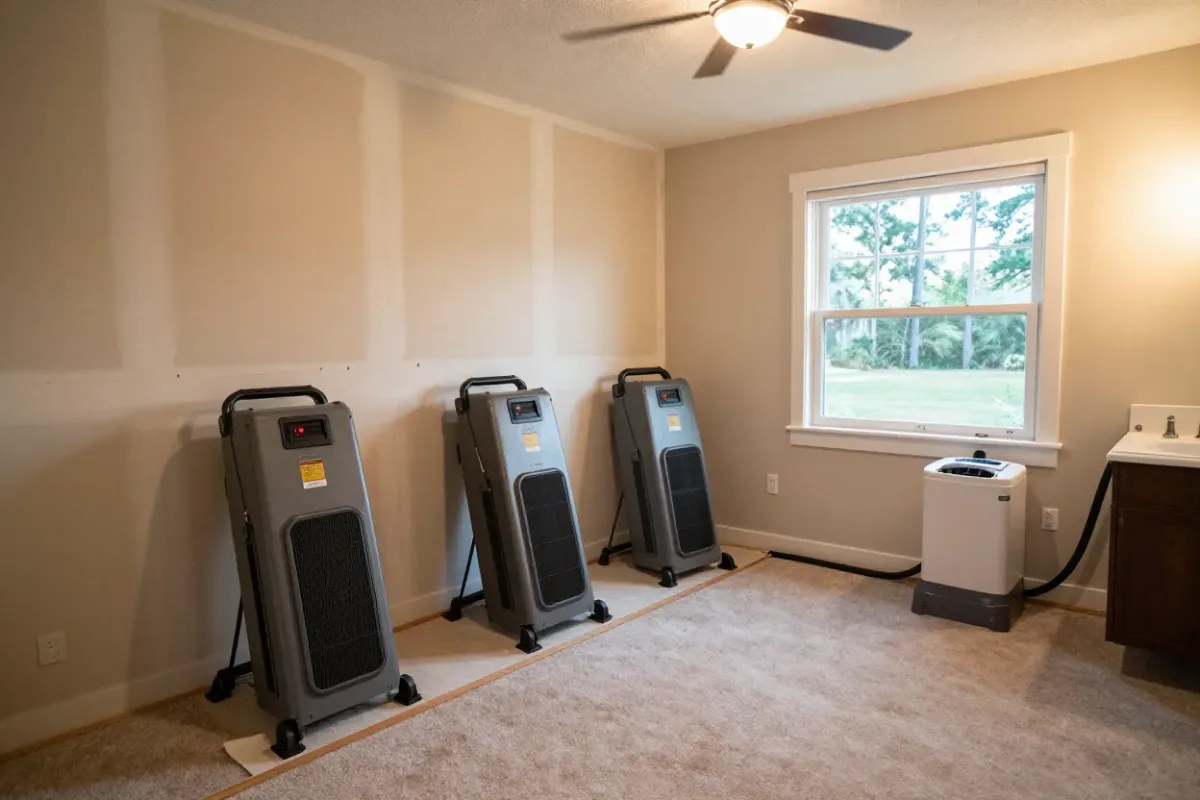
Drying is done with the house closed and the air conditioning running, using dehumidifiers matched to the volume of the space and air movers aimed at the wet assemblies. Readings are logged daily, and the drying phase ends only when each material is back to its dry standard, not when a set number of days has passed. Cleaning, antimicrobial treatment where warranted, and the rebuild follow in that order. Read more about our full water damage restoration service.
Flood Cleanup When the Swales and Canals Back Up
Rain flooding is Sebastian's most common flood scenario. Because the drainage grid discharges to the St. Sebastian River and lacks modern storage, a heavy, slow-moving storm fills the ditches and swales faster than they can empty, and the overflow finds the lowest houses. The city maintains a dedicated stormwater utility and publishes flood maps and hurricane-preparedness guidance for exactly this reason. Coastal storms add another layer: Frances and Jeanne in 2004 caused severe beach erosion from Vero Beach north, and Hurricane Nicole came ashore at Vero Beach in 2022, close enough that Sebastian felt its wind and rain.
Water that has crossed a yard, a swale or a canal is contaminated, so flood cleanup means removing rather than drying the porous materials it touched: carpet and pad, the bottom of the drywall, insulation, and lower cabinets. Hard surfaces are cleaned and disinfected, and air scrubbers run during the work. Check our flood restoration page for the full process, and if water is rising now, our first 24 hours after a flood guide covers what to do until we arrive.
Water Damage Repair in Sebastian
Once drying is confirmed by moisture readings, repair returns the home to normal. In Sebastian that usually means replacing the lower section of drywall and the baseboards, reinstalling or replacing tile, plank or carpet flooring, resetting kitchen and bath cabinets, and repainting. We match textures and trim so the repaired area blends with the rest of the house, and we keep the scope tied to what was documented during mitigation.
Many Sebastian homeowners are retirees who want the disruption kept short and the work explained clearly. We schedule the rebuild as one continuous phase, keep the affected rooms contained from the rest of the house, and walk through each step with you before it happens. If a storm damaged the roof or exterior, we make sure the home is weather-tight before interior finishes go back in.
Mold Removal After Leaks and Flooding
In a single-story slab home, mold after water damage tends to show up in predictable places: the lower drywall behind baseboards, the back of kitchen and bath cabinets, closets on exterior walls, and the drywall around a garage that took swale water. A slow leak at a water heater or under a sink, common in homes built across the years since the original plat, can feed growth for weeks before it is visible.
Our mold removal starts with correcting the moisture source and containing the affected area under negative air pressure. We then remove and bag the affected porous materials, HEPA-vacuum and clean what remains, and dry the space to verified readings before any rebuild. Spraying over growth is not a solution we offer. See our mold remediation page and our article on hidden mold after water damage.
Frequent Causes of Water Damage in Sebastian
A large residential city on a mid-century drainage grid, with an older population and a long humid season, sees water damage from a fairly consistent set of sources:
- Heavy rainfall overwhelming the GDC-era canals, ditches and swales
- Water entering garages and low slab floors from flooded yards and streets
- Wind-driven rain through roofs and windows during hurricanes and tropical storms
- Water heater failures in garages and utility closets
- Supply-line and slab leaks in homes with aging plumbing
- Washing machine hose and dishwasher failures that run unnoticed overnight
- Air conditioning condensate line clogs during the summer cooling season
- Extended power outages that stop the air conditioning and let humidity build inside
Eight Steps from Wet to Rebuilt
Every Sebastian job follows this order. Finishing and verifying each step before the next is what keeps a repaired wall from becoming a mold problem later.
- InspectionWe confirm the source is stopped, determine whether the water is clean or contaminated, and map moisture through drywall, floors and cabinets with meters and thermal imaging.
- ExtractionPumps and extraction units remove standing water from garages, slab floors and carpet, with generator power when the grid is down.
- Removal of damaged materialsWet drywall, baseboards, insulation, carpet pad and swollen cabinet bases are cut out and bagged so the block and framing behind can dry.
- Drying and dehumidificationAir movers and a dehumidifier sized to the house run continuously with the doors and windows shut, and daily readings tell us when the drywall, cabinets and slab are dry.
- CleaningSurfaces reached by swale, canal or long-standing water are cleaned and disinfected, and air scrubbers filter the space.
- DocumentationWe build a claim file of dated photos, the moisture log, equipment records and a written scope, and give you a copy as well as your carrier.
- RepairDrywall, trim, flooring, cabinets and paint are restored so the room matches the rest of the house.
- Final verificationClosing moisture readings and a walkthrough confirm the work is complete.
Coverage Across Sebastian
We serve the entire city, from the older waterfront area near the St. Sebastian River and the lagoon, where the original fishing village grew up, to the broad residential sections laid out across the GDC plat and the newer subdivisions on the city's edges. Our crews know the drainage layout and how water moves through it, and they size their equipment for the single-story slab homes that make up most of the community.
Nearby Communities
Our Sebastian crews also cover the surrounding communities in northern Indian River County and southern Brevard County. Several have their own local pages:
What to Do Before Our Crew Arrives
These steps are safe for most Sebastian homeowners and will limit the damage. If any of them would require stepping into water, skip it and wait for us.
- Shut off the waterFor a plumbing failure, close the fixture valve or the main shutoff at the house. If the leak is from the roof, wait for the storm to pass before anyone goes outside.
- Keep clear of electricityNever enter standing water that could be touching outlets, extension cords, appliances or the panel. Shut off circuits only if the panel is dry and you can reach it on dry ground.
- Do not drive or wade into flooded swales and ditchesFlooded ditches in Sebastian can be far deeper than they look. Stay on high ground and treat any outdoor flood water as contaminated.
- Get belongings upMove furniture, rugs, electronics and paper records to a dry room, or set furniture on blocks if it cannot be moved.
- Photograph the damageTake pictures and video of the source, the water level and every affected room before anything is moved. This record supports your claim.
- Keep the house cool and closedIf you have power, keep the air conditioning on and the windows shut. Outside air in Sebastian carries more moisture than the room you are trying to dry.
- Call Water Damage FloridaReach us at (888) 435-4769 with the source, when it started and whether the water came from outside, and we will dispatch a crew.
For storm preparation and recovery, read our hurricane water damage recovery guide.
Sebastian Water Damage FAQs
Why does my Sebastian yard flood so easily during a heavy rain?
The city's drainage network was built in the late 1950s for the original GDC plat and relies on canals, ditches and swales that drain to the St. Sebastian River. The city notes it lacks modern storage, so a slow, heavy storm can fill the system faster than it drains and push water toward the lowest homes.
Is swale or canal water that got into my garage dangerous?
It should be treated as contaminated. It has crossed yards, streets and ditches and can carry sewage and chemicals. Keep people and pets out of it, and let our crew extract it, remove soaked materials and disinfect the surfaces.
Do you provide generator power if the electricity is out after a storm?
Yes. We bring generators for extraction and drying equipment when utility power is down, so mitigation can start without waiting for the grid to come back.
How disruptive is the drying process in a single-story home?
We contain the affected rooms, run equipment only where it is needed, and keep the rest of the house usable. The equipment is loud and the rooms will be off limits until readings confirm they are dry, but most families stay in their home during the work.
Can you handle the paperwork for my insurance claim?
We supply the documentation the claim depends on: arrival photos, daily moisture logs, equipment records and a written scope. You remain in charge of the claim and the conversation with your adjuster.
Do you also serve Micco, Roseland and Vero Beach?
We do. Our crews cover all of Indian River County and the neighboring communities in southern Brevard County, and Water Damage Florida operates statewide. Visit our service areas to find the nearest page.