Roughly a quarter of Stuart's area is water. The Martin County seat sits where the St. Lucie River meets the Indian River Lagoon near the St. Lucie Inlet, with the Atlantic a short distance beyond, and its average elevation is only about ten feet. That is a beautiful place to keep a boat and a demanding place to keep a house dry. Water Damage Florida provides round-the-clock water damage restoration in Stuart, whether the problem is river water in a low garage, a failed pipe inside a historic downtown building, or a roof opened up by a passing hurricane.
We work in the historic downtown, the residential streets of East Stuart, and the neighborhoods along both the river and the lagoon. Our crews bring extraction, drying, containment and documentation equipment on every emergency call so the work begins the moment we arrive. If you have water where it should not be, call (888) 435-4769 and we will get moving.
24/7 Emergency Water Damage Help in Stuart
Stuart's storm history is long. Hurricane Isbell in 1964 and Hurricane David in 1979 both passed through, Frances and Jeanne both made landfall on Hutchinson Island near the city in 2004, with Jeanne damaging thousands of homes across Martin County, and Wilma followed in 2005. Gusts of about 100 mph were recorded on Hutchinson Island in Martin County during Irma in 2017. Even Nicole in 2022, which caused only minor damage on Sewall's Point and Stuart Beach, showed how quickly wind and water can reach the shoreline. Emergency calls after these events are about intrusion: rain through a damaged roof, surge in a ground floor, wind-driven water past doors and windows.
Between storms, the emergencies are quieter but just as wet: a supply line that lets go overnight, a water heater that fails in a closet, a washing machine hose in a home that sits empty half the year. In every case our first-visit priorities are the same. Stop the source, extract standing water, remove what is already ruined, and set drying equipment before moisture climbs further into the walls. Photos and moisture readings taken on arrival become the start of your insurance file. See our emergency water damage page for how we handle the first hours.
Restoring Historic Buildings and Waterfront Homes
Downtown Stuart holds notable historic buildings dating from the 1880s through the 1940s, in styles ranging from Colonial Revival to Mediterranean and Art Deco, and East Stuart is a historic, mostly residential neighborhood on the older east side of town. Restoring water damage in buildings like these means respecting old plaster, original wood, stucco over masonry and decorative details that cannot be bought at a supply house. We identify the wet materials with meters and thermal imaging, then dry as much as possible in place, removing only what is beyond saving.
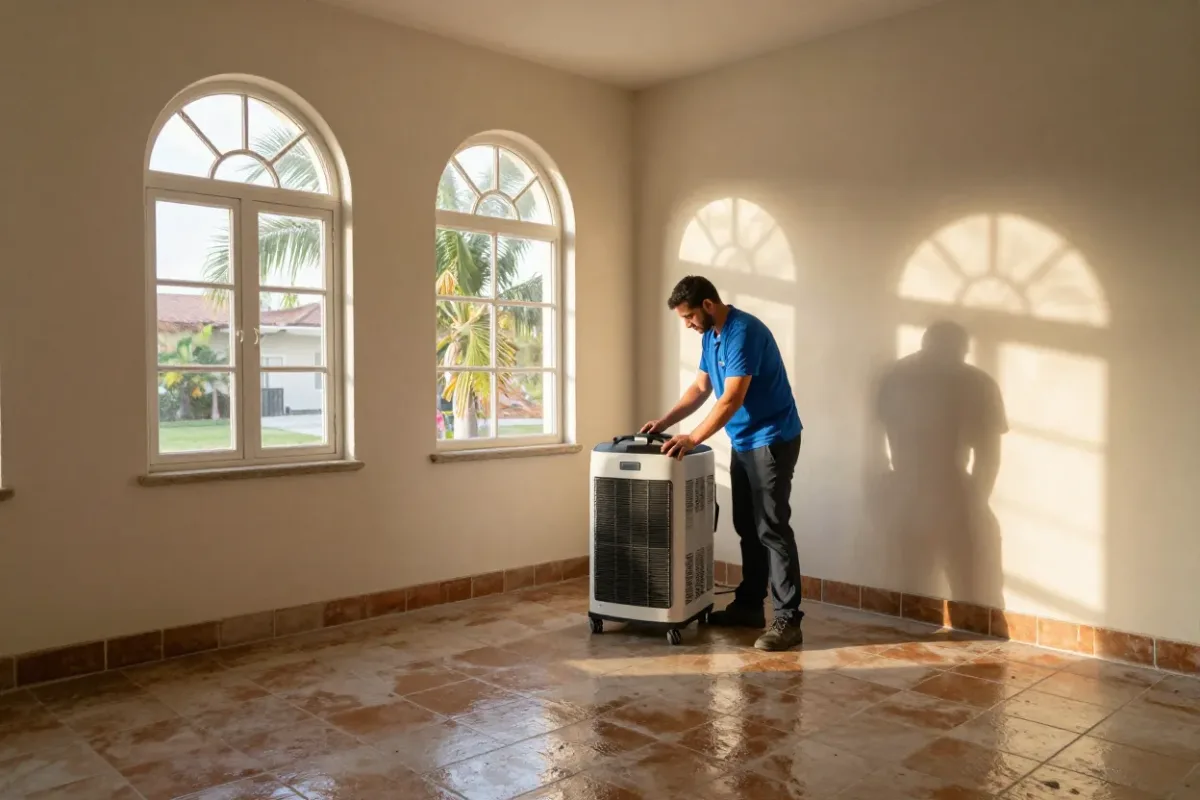
Waterfront homes present the opposite challenge: modern finishes over slab and block, but with water that often carries salt and silt. Drying either kind of property in Stuart's humid climate means keeping the building closed, running dehumidifiers matched to the volume of the space, and logging readings daily until every material is back to its dry standard. Only then does restoration move on to cleaning and rebuilding. Learn more about our full water damage restoration service.
Flood Cleanup Along the St. Lucie River and Lagoon
Because Stuart is nearly surrounded by the St. Lucie River, the Indian River Lagoon and the nearby Atlantic, both storm surge and river flooding are real concerns, and the city's low elevation leaves little margin. The city operates a stormwater division for a reason: heavy rain has to travel a short distance to reach the river, and when the river is high the water backs up into the same streets it usually drains. Flood cleanup calls come from waterfront garages, ground-floor storage, docks and boathouses, and older homes on low lots in East Stuart.
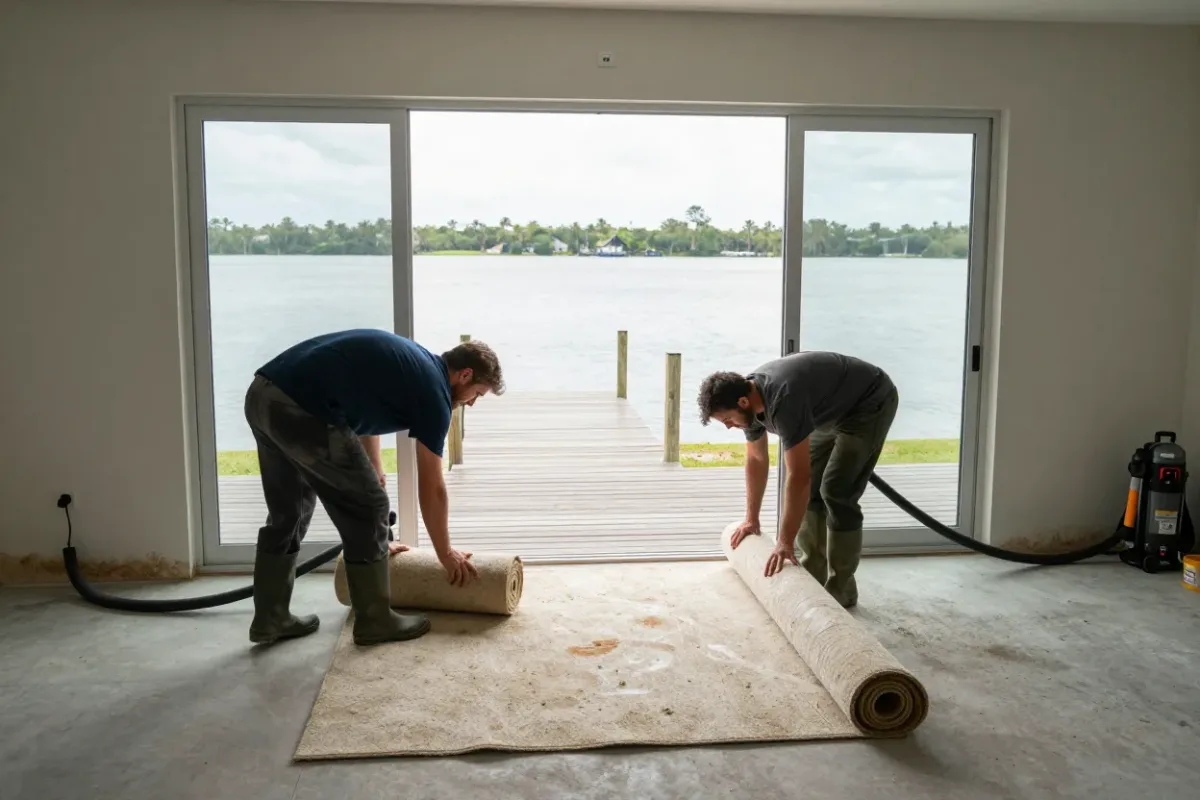
River and lagoon water is brackish and contaminated, so flood cleanup means removal rather than drying for porous materials. Carpet, pad, drywall, insulation and particleboard cabinets that sat in it come out; block, tile and concrete are cleaned and disinfected; and air scrubbers run while the space dries. We also look at electrical outlets, appliances and dock wiring the water reached. Our flood restoration page covers the process in detail, and if the water is still rising, our first 24 hours after a flood guide tells you what to do right now.
Water Damage Repair in Stuart
After drying is verified by moisture readings, repair puts the building back. In a historic downtown property that can mean plaster patching, refinishing original wood floors, repairing stucco and repainting to match aged finishes. In a newer riverfront home it is more often new drywall, baseboards, flooring, cabinet bases and paint. We document what was removed and why, so the rebuild scope lines up with the mitigation record your adjuster already has.
Census data show a sizable share of seasonal or vacant units in Stuart, and repair work for absent owners is a regular part of what we do. We can meet a property manager or neighbor for access, send photo updates as the work progresses, and hold the final walkthrough when you are back in town. Where a storm damaged the roof or exterior, we coordinate so the interior rebuild does not start until the building is weather-tight.
Mold Removal for Seasonal and Year-Round Homes
A home that sits closed and unoccupied for months is the most common mold story we hear in Stuart. A small leak starts in a hot, still house, the air conditioning is set high or off, and by the time the owner returns the drywall behind a vanity or the closet on an exterior wall has visible growth. Older buildings add their own trouble spots: the void behind plaster, the framing under a wood floor, and the low walls of ground-floor spaces that took water during a past storm.
Our mold removal is methodical. We correct the moisture source first, build containment with negative air pressure, remove and bag affected porous materials, HEPA-vacuum and clean the remaining surfaces, and dry the area to verified readings before any rebuild begins. Surface sprays over growth are not a fix. For more, read our mold remediation page and our article on hidden mold after water damage.
Why Water Damage Happens in Stuart
A low riverfront city with a historic core and a large seasonal population sees a particular mix of losses. The causes we encounter most often in Stuart are:
- Storm surge and river flooding in low-lying waterfront and ground-floor spaces
- Roof and window damage from hurricanes crossing Hutchinson Island and Martin County
- Leaks that go unnoticed for weeks in seasonal homes and vacant units
- Aging plumbing and drain lines in historic downtown and East Stuart buildings
- Water heater and appliance failures in utility rooms and garages
- Air conditioning condensate backups during the long humid season
- Heavy rain overwhelming stormwater drainage when the river is already high
- Dock, seawall and boathouse damage that lets water into adjacent living space
Our Water Damage Process from Arrival to Rebuild
Whether the job is a small kitchen leak or a whole ground floor after a storm, the sequence below does not change. Each stage is finished and checked before the next begins.
- Inspection and moisture mappingWe find the source, determine whether the water is clean or contaminated, and trace it through walls, floors and cavities with meters and thermal imaging.
- ExtractionStanding water is pumped and extracted from floors, garages and low rooms, with brackish river water handled as a contaminated source from the start.
- Removal of ruined materialsWet carpet, pad, drywall, insulation and swollen cabinetry are cut out and bagged; historic plaster and wood are removed only when they cannot be saved.
- Drying and dehumidificationAir movers and dehumidifiers run continuously in a closed building, and readings are logged each day until every material reaches its dry standard.
- Cleaning and disinfectionHard surfaces touched by contaminated water are cleaned and treated, and air scrubbers filter the space during and after demolition.
- DocumentationPhotos, moisture logs, equipment records and a written scope are compiled for you and for your insurance carrier.
- RepairDrywall, plaster, flooring, trim, cabinets and paint are restored, with period details matched in historic buildings.
- Final checkA closing round of moisture readings and a walkthrough confirm the space is dry and complete.
Where We Work in and Around Stuart
Our crews cover the entire city, from the marinas and historic storefronts downtown to the residential streets of East Stuart and the homes along the St. Lucie River and Indian River Lagoon shorelines.
Stuart Neighborhoods
- Downtown Stuart
- East Stuart
Surrounding Martin County Communities
We also serve the communities around Stuart, from the peninsula towns on the lagoon to the larger cities north and south along the coast. Some of these have their own pages:
What to Do While You Wait for the Crew
A few careful steps in the first hour reduce what has to be removed later. Nothing on this list requires tools or puts you at risk.
- Close the valveFor plumbing leaks, shut the fixture valve or the main. In a multi-unit or commercial building downtown, tell the property manager so the riser can be isolated.
- Do not walk through water near powerIf water could be touching outlets, cords, appliances or the panel, stay out of the room. If the panel is dry and you can get to it without stepping in water, you may shut off the affected circuits.
- Treat river and street water as unsafeWater from the St. Lucie River, the lagoon or a flooded street is contaminated. Keep people and pets out and do not try to clean it up yourself.
- Lift and separateMove furniture, rugs and electronics off wet floors, and pull wet items away from walls so air can reach both surfaces.
- Take photos firstPhotograph the source, the water line and every affected room before moving anything. This record supports your claim.
- Keep the house cool and closedRun the air conditioning and keep windows shut. Letting in outdoor humidity slows drying and gives mold what it needs.
- Call Water Damage FloridaReach us at (888) 435-4769 with the source, the timing and whether the property is occupied so we can plan access and equipment.
If a storm is on the way, the hurricane water damage recovery guide explains how to prepare a waterfront home and what to do once it passes.
Common Questions from Stuart Property Owners
Can you restore a historic downtown Stuart building without destroying its original features?
That is the goal on every historic job. Plaster, original wood floors and masonry can usually be dried in place when we start early and control the drying. We remove only what moisture readings show cannot recover, and we document the original details so repairs match.
What happens when the St. Lucie River comes into a ground floor?
River water is brackish and contaminated, so porous materials it soaked are removed rather than dried. We extract, cut out wet drywall and flooring, disinfect the hard surfaces, dry the structure and then rebuild. Outlets and appliances the water reached are flagged for inspection.
I found water damage in my Stuart home after being away for the season. Is it too late to save anything?
Usually not everything is lost, but time changes what can be saved. Long-wet drywall and cabinetry typically come out, while the structure itself often dries and recovers. We assess, contain any mold that has started, and give you a clear scope before work begins.
Do you help with the insurance claim?
We provide the documentation your claim depends on: photos from arrival, daily moisture logs, equipment records and a written scope that separates water damage from pre-existing conditions. You direct the claim; we make sure the record is complete.
How long does structural drying take in Stuart's climate?
It depends on the materials, how long they were wet and the water category. We do not promise a fixed number of days; we run equipment and take readings until each material reaches its dry standard, then confirm before repairs begin.
Do you cover Sewall's Point, Palm City and Jensen Beach as well?
Yes. Our Stuart crews serve all of Martin County and the neighboring areas along the Treasure Coast, and Water Damage Florida operates statewide. Browse our service areas for other communities.