Tamarac began in the early 1960s as a maintenance-free retirement community of small one-story homes built around shared clubhouses, and although the city is younger and more diverse today, that origin still shapes it. Large age-restricted condominium and villa communities remain a defining feature, and the city's irregular outline reflects the piecemeal land purchases of its founding developer. What every part of Tamarac shares is elevation, or the lack of it: at only a few feet above sea level, it is among the lowest-lying of Broward County's inland cities, and it is threaded with drainage canals and man-made lakes that its Stormwater Division maintains year-round.
Water Damage Florida provides water damage restoration in Tamarac 24 hours a day, with crews experienced in the particular problems of older villa and condominium communities: shared walls, shared plumbing, seasonal occupancy and slab-on-grade construction that lets water travel a long way before it is seen. We extract, dry, remove what cannot be saved, clean up mold and rebuild, and we document the work for your insurance claim. Call (888) 435-4769 the moment you find water.
Emergency Water Extraction in Tamarac
In a villa community, a water emergency is rarely confined to one address. Units share walls, and often share the slab, so a water heater that fails in one villa wets the carpet in the next before either resident notices. In a condominium, a supply-line failure on an upper floor comes down through the ceiling of the unit below. And because so many Tamarac homes are occupied seasonally, a leak that starts in June may not be discovered until the owners return in the fall, by which point the water has spread as far as it can go.
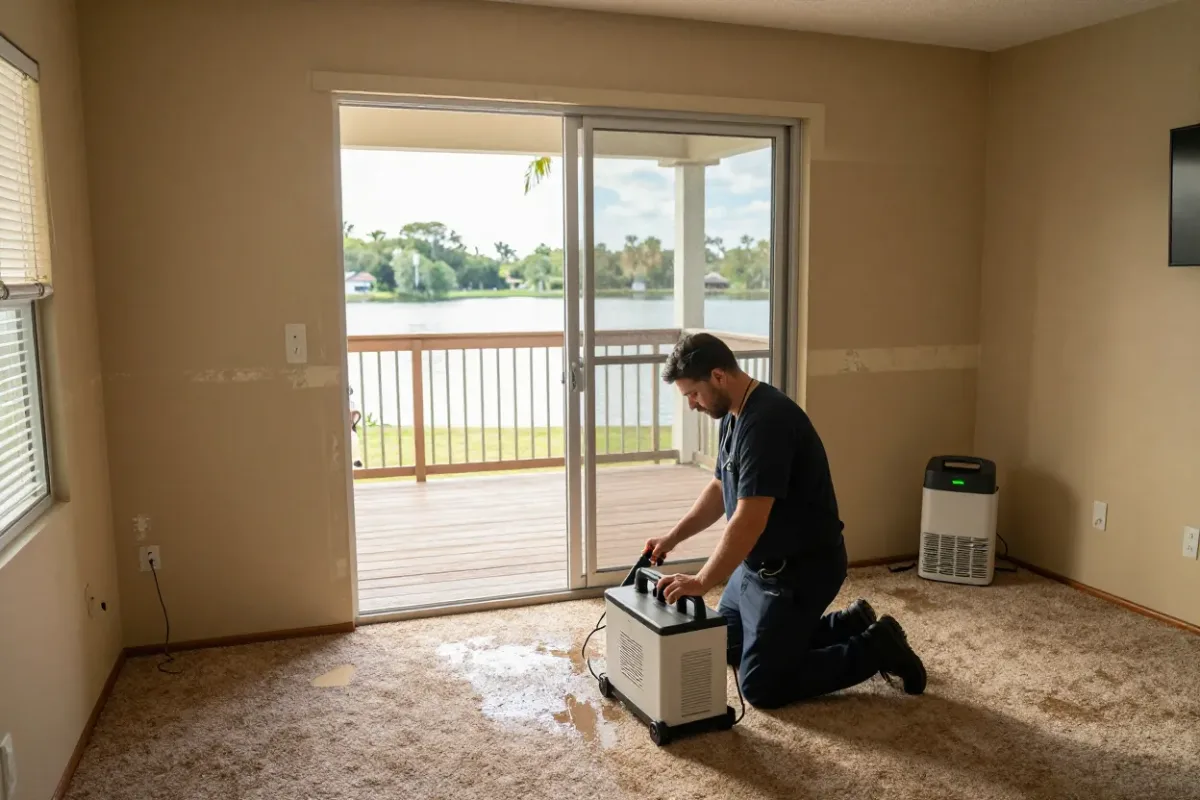
Our emergency crews arrive with portable extractors suited to small interiors as well as truck-mounted units for larger losses, and set air movers and dehumidifiers on the first visit. We check adjoining units with moisture meters whenever the building type makes shared damage likely, photograph everything, and record baseline readings before removal begins. See our emergency water damage page for what to expect in the first hours.
Restoring Villas, Condominiums and Single-Family Homes
Tamarac's original housing was small: one- and two-bedroom retirement homes with fee-based exterior maintenance, clustered around clubhouses. Many of those homes and the condominium and villa communities that followed are still occupied, and their construction is consistent: concrete block on a slab, drywall or paneling inside, tile or terrazzo under later carpet or vinyl. Water in a building like this pools on the slab and wicks into the lowest foot of every wall it touches. The newer single-family neighborhoods around the city's lakes add wood-look flooring, larger cabinets and two-story layouts to the list of materials at stake.
Our restoration method is the same for each. We map every wet material with moisture meters and thermal imaging, remove what cannot be dried, and dry the rest with the unit closed up and dehumidifiers sized to the space. We log readings every day until each material is at its dry standard; cleaning, treatment and repair wait for that. Our water damage restoration service page describes the full method.
Flood Cleanup in One of Broward's Lowest Cities
Tamarac is far from the coast, so flooding here is a rainfall problem rather than a surge problem. Heavy rain from tropical systems is the main driver, and the city's low elevation means water that falls has very little slope to drain along. Many neighborhoods are built around man-made lakes and rear-lot canals, and when those fill during a prolonged storm, water rises toward patios, lanais and the rear rooms of the homes that back onto them. The city's Stormwater Division clears drainage structures and maintains the canals and lakes, and the city has completed a comprehensive stormwater vulnerability assessment, but no drainage system moves a foot of rain instantly.
Water that has crossed a lawn, a street or a parking lot is contaminated, and so is water backing up from a lake or canal. Flood cleanup therefore means removing saturated carpet, pad, the lower portion of drywall and wet insulation rather than drying them in place, then cleaning and disinfecting hard surfaces while air filtration runs. Our flood restoration page covers this work in more detail, and the first 24 hours after a flood guide explains what to do while you wait.
Repair Work Once the Readings Are Dry
Repair in Tamarac often involves small units where every square foot matters, so we plan the rebuild to return the space to use quickly: replacing cut drywall and baseboard, reinstalling or replacing flooring, rehanging vanities and kitchen cabinets pulled for drying, repainting, and in condominiums rebuilding the ceiling below an upper-unit leak. In the older villas we frequently uncover original terrazzo beneath carpet, and many owners choose to keep it exposed rather than recarpet.
Because the repair scope comes from the photos and moisture logs gathered during mitigation, your adjuster sees exactly what was affected and why. In association-governed communities we coordinate on work hours, access and shared-element repairs, and we keep documentation separate for each unit so owners and the association each have a clean record.
Mold Removal for Tamarac Homes and Condos
Seasonal occupancy is the biggest mold factor in Tamarac. A unit left closed for months with the air conditioning set high, a slow leak under a sink, or a window seal that failed during a summer storm can produce growth across a whole wall by the time anyone opens the door. Beyond that, the usual suspects apply: drywall behind bathroom tile, the cavity beneath kitchen base cabinets, the lowest course of wall behind furniture in a room that was mopped but never extracted, and the closet that houses the air handler.
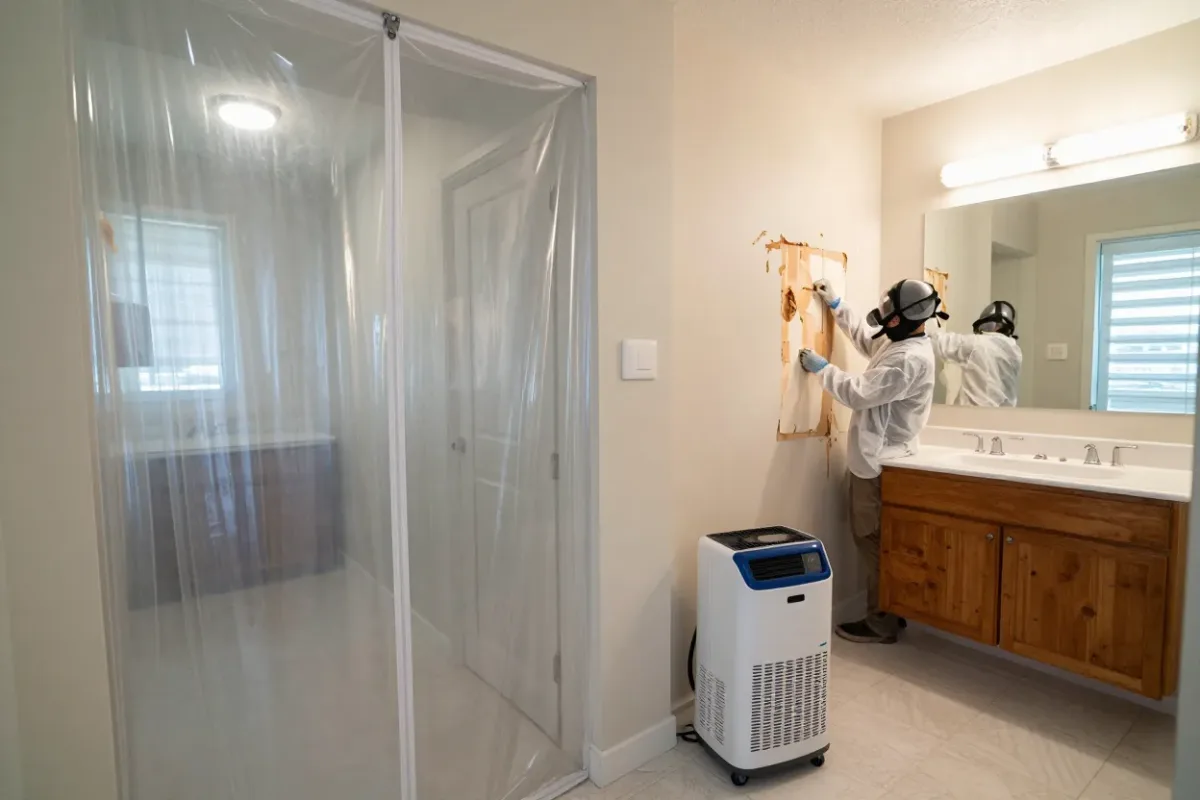
Mold removal starts with correcting the moisture source, then containing the area with plastic sheeting and negative air, removing and bagging affected porous materials, HEPA-vacuuming and cleaning what remains, and drying the space completely before rebuilding. Painting over growth is never part of the plan. See our mold remediation page for the full process and our article on hidden mold after water damage for the places it hides.
Where Water Damage in Tamarac Usually Starts
A low-lying city of older villas, condominium communities and lakefront subdivisions, many of them seasonally occupied, produces a predictable set of water losses. The causes we see most in Tamarac are:
- Leaks in seasonally vacant units that run for weeks before discovery
- Water heaters and original supply lines in 1960s and 1970s villas reaching the end of their service life
- Shared-wall and shared-slab water migration between attached villa units
- Upper-floor condominium leaks coming through the ceiling of the unit below
- Lake and canal water rising into rear patios and rooms during prolonged tropical rain
- Air conditioning condensate overflows in interior closets
- Roof and window leaks during wind-driven storms
- Slab leaks beneath terrazzo and tile floors in older homes
- Street and yard flooding on the lowest lots when drainage structures cannot keep up
Eight Steps From Wet to Finished
Every Tamarac project follows the same sequence, and each stage is verified before the next starts. That discipline is what keeps a repaired wall from becoming a mold problem later.
- Inspection and moisture mappingWe confirm the source, classify the water, and map every wet material with meters and thermal imaging, including shared walls and the adjoining unit where the construction makes that likely.
- Water extractionPortable and truck-mounted extractors remove water from carpet, tile and terrazzo; submersible pumps handle patios, lanais and garages after a storm.
- Removal of unsalvageable materialsSaturated carpet and pad, the lower section of wet drywall, damaged paneling and wet insulation are cut out and bagged.
- Drying and dehumidificationAir movers and dehumidifiers run continuously in the closed unit, and moisture readings are logged daily until every material reaches its dry standard.
- Cleaning and treatmentSurfaces that contacted contaminated water are cleaned and disinfected, with HEPA filtration running during the work.
- DocumentationPhotos, daily readings, an equipment log and a written scope are assembled for you and your insurance carrier, separated by unit where more than one is involved.
- RepairDrywall, baseboard, flooring, cabinets and paint are restored, with association requirements handled where they apply.
- Final verificationA closing round of readings and a walkthrough with you confirm the unit is dry, complete and ready to occupy.
Tamarac Communities We Serve
We respond throughout Tamarac's irregular footprint, from the original Tamarac Lakes and Mainlands sections to the condominium communities of Kings Point and the lakefront neighborhoods on the west side. Our crews bring equipment suited to a compact villa, a mid-rise condominium or a two-story single-family home.
Tamarac Neighborhoods
- Tamarac Lakes
- The Mainlands of Tamarac Lakes
- The Woodlands
- Kings Point
- Woodmont
- Westwood
- Sabal Palm Village
- Colony West
- Heathgate
- Sunflower
- Lime Bay
- Spring Lake
Nearby Communities
Tamarac's borders touch several other west-central Broward cities, and our crews serve all of them. Neighbors with their own service pages include:
What You Can Safely Do Right Now
These steps limit the damage while our crew is on the way. If any of them feels unsafe, skip it and wait for us.
- Turn off the waterClose the valve at the fixture or the main shutoff. In a villa or condominium, notify the association or management so a shared line can be isolated if needed.
- Avoid water near electricityDo not step into a wet room where outlets, cords or appliances may be in contact with water, and never touch a wet electrical panel. Switch off a breaker only if the panel is dry and you can reach it without wading.
- Tell your neighborIn an attached villa or a condominium, let the adjoining or downstairs resident know so they can check their own walls and floors.
- Move belongings upLift rugs, furniture legs and stored items off the wet floor and set foil or plastic under anything that must stay.
- Photograph before cleanupDocument the source, the extent of the water and each affected room before anything is discarded.
- Keep the air conditioning runningCool, dry air slows microbial growth. Keep windows and sliding doors closed rather than airing the unit out.
- Call (888) 435-4769Tell us the source, how long it has been wet, and whether the unit is attached to others.
Tamarac Water Damage FAQs
We came back for the season and found the unit had a leak all summer. What should we expect?
Expect the water to have traveled further than it looks, and expect mold to be part of the job. We inspect with containment in place, check adjoining units, document everything for your claim, then remove affected materials, dry the structure and rebuild. Call before moving furniture or opening walls yourself.
My villa shares a wall with my neighbor's. Can water from their unit damage mine?
Yes, and it does regularly. Attached villas often share a slab and a wall cavity, so water from one side wicks into the other. When we respond to a villa loss we meter the shared wall from both sides and document each unit separately.
Is Tamarac at risk of flooding even though it is inland?
It is one of the lowest-lying inland cities in Broward County, only a few feet above sea level, with many neighborhoods built around lakes and canals. Heavy tropical rain is the main flood driver, and the homes that back onto water or sit on the lowest lots see it first.
Can the original terrazzo in my 1960s home be saved?
Usually, yes. Terrazzo is a hard, non-porous floor that tolerates water well once the carpet or vinyl on top is removed and the slab beneath is dried. Many owners take the opportunity to restore it rather than recarpet.
Do you work with condominium associations in Kings Point and similar communities?
Yes. We coordinate with management on access, work hours and shared elements, protect hallways and common areas, and keep separate documentation for each affected unit so owners and the association each have their own record.
How will I know the drying is really done?
We show you the numbers. Moisture readings are taken every day and compared to the dry standard for each material, and equipment is removed only when those readings are met. You receive the log.