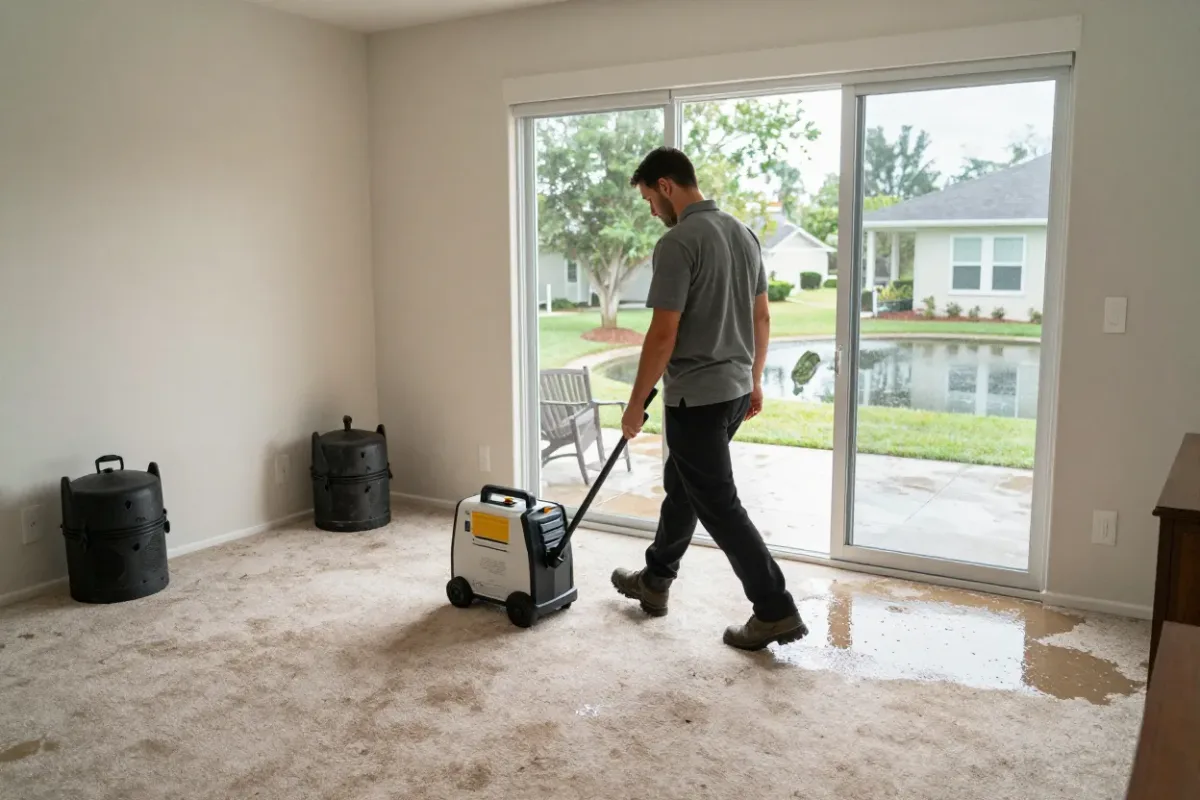
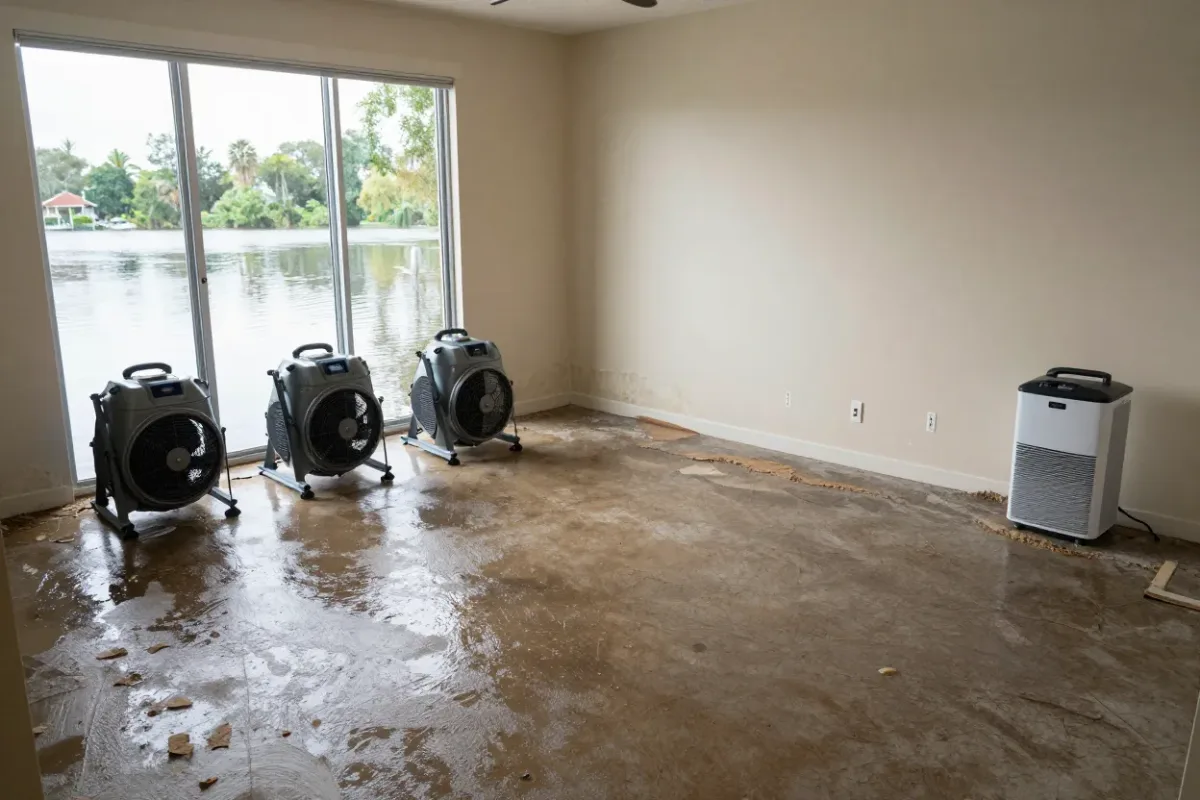
Kissimmee is lake-and-creek country. The city sits on the northwest shore of Lake Tohopekaliga, Shingle Creek threads through it as the headwaters of the Everglades, and Boggy Creek and Reedy Creek carry runoff down from Orange County into the Osceola lake system. When it rains hard upstream, that water passes through Kissimmee on its way to the Kissimmee River, and when a storm stalls over Central Florida the lakes keep rising for days after the sky clears. That is the backdrop for water damage here, and it is why Water Damage Florida keeps crews available around the clock for emergency water damage work in Kissimmee.
We handle the ordinary losses too: a washing machine hose that lets go in a Buenaventura Lakes ranch home, a condensate line overflowing in the attic of a Storey Lake townhouse, a roof leak in a manufactured home near Pleasant Hill. Whatever the source, the job is the same: stop it, remove the water, dry the structure down to verified moisture readings, and put the home back together. Call (888) 435-4769 at any hour and a crew will be dispatched to your address.
Emergency Response When Water Is Still Coming In
The Kissimmee calls that reach us at two in the morning fall into a few patterns. A supply line or water heater fails in a newer subdivision home and the first floor is wet before anyone wakes up. A summer thunderstorm finds a lifted shingle or a failed flashing and drips through a bedroom ceiling. Or, in the worst weeks, a lake or creek that has been rising quietly for days finally reaches the slab of a home in a low-lying pocket near Shingle Creek or the East Lake Toho shoreline. All three need the same first hour: source stopped, standing water removed, air moving before the drywall and cabinets wick it upward.
Our crews arrive with portable and truck-mounted extractors, submersible pumps for garages and lanais that have become ponds, and enough air movers and dehumidifiers to start drying on the first visit. We photograph and meter everything on arrival so your insurance file begins with a clear record. If a senior community, apartment building or vacation-area property has several units affected, we work through the whole footprint rather than the one door that called.
Water Damage Restoration for Kissimmee Homes
Restoration covers the entire arc from wet emergency to finished room. After extraction we map moisture through every affected wall, floor and cabinet run with meters and thermal imaging, then decide material by material what can be dried in place and what must come out. Kissimmee's housing runs from an older historic district downtown to large master-planned communities like Tapestry, Tohoqua and Bellalago, so the answer varies: a plaster wall in a downtown bungalow behaves differently from the paper-faced drywall and laminate floors in a home built last year, and both differ again from the floor systems of a manufactured home.
Drying in Central Florida's humidity has to be engineered. We close the home up, size dehumidifiers to the space, position air movers to push moisture out of wall cavities and off subfloors, and take readings daily until every material is back to its dry standard. Only then does cleaning begin, followed by any antimicrobial treatment the water category calls for, and then the rebuild. Our statewide water damage restoration service page explains that sequence in more depth.
Flood Cleanup After Lake Toho and Shingle Creek Rise
Hurricane Ian in 2022 showed how flooding works in Kissimmee. Historic rainfall overwhelmed local drainage, county officials flagged Shingle Creek, Lake Toho and East Lake Toho as extreme flooding areas, and lake levels kept climbing for days after the storm passed. Good Samaritan Village, a senior community, went under mandatory evacuation, and some of its units were later declared uninhabitable. Water that lingers for days does far more damage than water that drains overnight, because it saturates slabs, wicks high into walls and gives microbial growth a running start.
Lake, creek and street water is treated as contaminated. Flood cleanup in Kissimmee therefore means removing porous materials that soaked rather than trying to dry them, disinfecting the hard surfaces that remain, and running air filtration while the structure dries. Homes on low ground near the lakes and creeks are the first we look at, along with manufactured homes whose floor systems sit close to grade. If floodwater is in your home right now, keep people and pets out of it and call; our flood restoration crews can talk you through the safe first steps while they are on the way.
Repairing the Damage Once the Readings Say Dry
Repair begins only when the moisture logs confirm the structure is dry. In Kissimmee that usually means replacing the lower courses of drywall and baseboard, reinstalling or replacing flooring that buckled, rehanging cabinets whose toe-kicks swelled, repainting, and addressing ceilings below a roof or attic leak. In the downtown historic district we try to save original wood floors and trim wherever early drying makes that possible; in newer subdivisions the priority is matching builder-grade finishes so the repaired room does not look patched.
Manufactured and mobile homes need their own approach. Osceola County has a large stock of them, and they took heavy damage from Hurricane Irma in 2017, so we are used to belly board, underfloor insulation and particleboard subfloors that behave differently from site-built construction. Repair scope stays tied to the moisture maps and photographs from mitigation, so your adjuster can see exactly which materials the water reached.
Mold Removal in Kissimmee
Warm temperatures and high humidity mean that any moisture left inside a wall cavity or under a floor in Kissimmee can support visible growth in a matter of days. We find it most often behind tub surrounds, at the back of kitchen base cabinets after a slow dishwasher leak, along the bottom of exterior walls in homes that took lake or creek water, and in closets next to air handlers where condensate has dripped unnoticed.
Our mold cleanup follows a fixed discipline: correct the moisture source, contain the area with plastic sheeting and negative air pressure, remove and bag affected porous materials, HEPA-vacuum and clean the surfaces that stay, and confirm the space is dry before anything is rebuilt. We never spray over growth and call the job done. Our mold remediation page covers the method, and this guide to hidden mold after water damage is worth reading before you repaint a wall that was once wet.
Where Kissimmee Water Damage Usually Starts
The pattern of losses we see in Kissimmee follows the city's geography and building stock: a basin that collects runoff from the north, a fast-growing ring of new subdivisions, an older core near the lakefront, and a sizeable number of manufactured homes and senior communities. The most common sources are:
- Lake and creek flooding when heavy rain upstream drains through Shingle Creek, Boggy Creek and Reedy Creek into Lake Toho and East Lake Toho
- Roof, soffit and flashing damage from hurricane winds, as the city saw with Charley, Frances and Jeanne in 2004 and Irma in 2017
- Supply line, water heater and appliance hose failures in two-story subdivision homes, where water travels through the ceiling below
- Air conditioning condensate lines overflowing in attics and closets through the long cooling season
- Wind-driven rain entering through windows, sliding doors and lanai enclosures during tropical storms
- Slab and under-floor pipe leaks in older homes near the downtown historic district
- Water intrusion through skirting and underfloor areas of manufactured homes on low ground
How a Kissimmee Water Damage Job Unfolds
Each job runs through the same eight stages, in order. The order exists because materials rebuilt over moisture that was never verified dry will be wet again, and the second loss is always worse than the first.
- Find the source and map the moistureWe confirm where the water came from, classify it as clean, gray or contaminated, and meter every wall, floor and cabinet it could have reached, including the room below in a two-story home.
- Pump and extract standing waterSubmersible pumps clear garages, lanais and flooded ground floors; portable and truck-mounted extractors pull water out of carpet, pad and the surface of slabs.
- Remove what cannot be savedSaturated drywall, wet insulation, swollen baseboard and delaminated flooring are cut out and bagged, especially after lake or creek water.
- Dry the structureAir movers and dehumidifiers run in a closed home, positioned to drive moisture out of framing and slab, with readings taken every day until the numbers match the dry standard.
- Clean and treatHard surfaces the water touched are cleaned, contaminated areas are disinfected, and HEPA air filtration runs throughout the work.
- Build the recordMoisture logs, photographs and a written scope are assembled for you and your insurance carrier.
- Repair and rebuildDrywall, trim, cabinetry, flooring and paint are restored so the room blends with the rest of the home.
- Verify and hand backA final moisture check and walkthrough confirm the structure is dry and the space is ready to live in.
Kissimmee Areas We Serve
We respond throughout Kissimmee and the rest of Osceola County, from the historic district near Lakefront Park to the newest phases of master-planned communities on the city's growing edges. Our crews bring equipment matched to an older lakefront home, a manufactured home on a low lot, or a two-story stucco house built in the last few years.
Kissimmee Neighborhoods
- Downtown Kissimmee (Kissimmee Historic District)
- Buenaventura Lakes (BVL)
- Bermuda Bay
- Tapestry
- Remington
- Mill Run
- Tohoqua
- Bellalago
- Pleasant Hill
- Shingle Creek Reserve at the Oaks
- Kissimmee Bay
- Storey Lake
- Four Corners
Nearby Communities
The same lake system and the same storms affect the communities around Kissimmee, and our crews cover them as well. Several have their own local pages:
What to Do Before the Crew Arrives
A few careful actions in the first hour will limit the damage without putting anyone at risk.
- Shut off the source if it is a plumbing failureClose the valve under the fixture or the main shutoff near the hose bib. If the water is coming from a lake or creek, there is nothing to shut off; focus on the steps below.
- Keep clear of water that could be energizedDo not walk into a flooded room where outlets, power strips or the panel may be wet. Cut power only if the breaker panel is dry and reachable without stepping in water.
- Assume lake, creek and street water is contaminatedKeep children and pets away from it, avoid skin contact, and leave that cleanup to a crew with protective equipment.
- Raise what you canPut furniture legs on blocks or foil, lift rugs, and move electronics and documents to a dry room or upstairs.
- Document before touching anythingPhotograph the source, the waterline, and every wet room and belonging before anything is moved.
- Leave the air conditioning onCool, dry air slows microbial growth while you wait. Do not open windows to the humid outdoors.
- Call and describe what you seeReach Water Damage Florida at (888) 435-4769 and tell us the source, how long it has been wet, and whether the water is still rising.
If the loss is storm related, our first 24 hours after a flood checklist and the hurricane water damage recovery guide cover the longer road ahead.
Kissimmee Water Damage Questions
The lake near my home is still rising days after the storm. Should I wait for it to go down before calling?
No. Call as soon as water is in or near the structure. After Hurricane Ian, lake levels in the Kissimmee area kept rising for days, and homes that waited for the water to recede spent that whole time soaking. We can protect what is above the waterline, set up drying in the dry parts of the home, and be ready to extract the moment the level drops.
Do you work on manufactured and mobile homes in Osceola County?
Yes. Manufactured homes are a significant part of the county's housing and they took heavy damage from Hurricane Irma. Their floor systems, skirting and underfloor insulation need a different drying approach from a slab home, and our crews are set up for that work.
Can you handle a senior community or apartment complex with many affected units?
We can. Multi-unit losses in Kissimmee are common, and we coordinate with management, work through the full extent of the water, and document each unit separately so residents and the property each have what they need for their claims.
Is water from Shingle Creek or Lake Toho treated differently from a pipe leak?
Yes. Creek and lake water is contaminated, so porous materials it touched are removed rather than dried in place and hard surfaces are disinfected. A clean supply-line leak caught early lets us save far more of the home.
Will you work with my insurance company?
We document the source, the extent of the water and every step of the work with photographs and moisture logs, and provide that record to you and your adjuster. The claim remains yours; our job is to make sure it is supported by clear evidence.