St. Cloud sits on the southern shore of East Lake Tohopekaliga in Osceola County, just east of Kissimmee and southeast of Orlando. It was founded as a colony for Civil War veterans and still markets a small-town, lakefront identity, but it has become one of the fastest-growing suburban areas in the region, with new subdivisions spreading east toward Narcoossee and Harmony. Growth has put a great many newer homes on flat ground near a very large lake, and East Lake Toho does not drain quickly when a storm sits over Central Florida for a day.
Water Damage Florida provides water damage restoration throughout St. Cloud 24 hours a day, from the older grid of homes near the historic downtown and Lakefront Park to the newest master-planned communities on the east and south sides. Call (888) 435-4769 at any hour and we will get a crew moving toward your address.
Emergency Response When Water Is Rising
In St. Cloud, the most memorable emergency is a slow one. After Hurricane Ian in 2022, East Lake Toho swelled for days, the city issued voluntary evacuations for more than a dozen areas, and streets along Blackberry Creek ran like rivers. A vandalized outflow structure north of the lake was blamed for faster rises. Homeowners in Blackberry, Pemberly Pines, Summer Cove, Sugar Mill, St. Cloud Village, Soleil Blue, Jade Isle, Savannah Park and Edgewater watched the water approach for days before it reached their doors. In that kind of emergency the first call should come while the water is still in the yard, not after it is in the hallway.
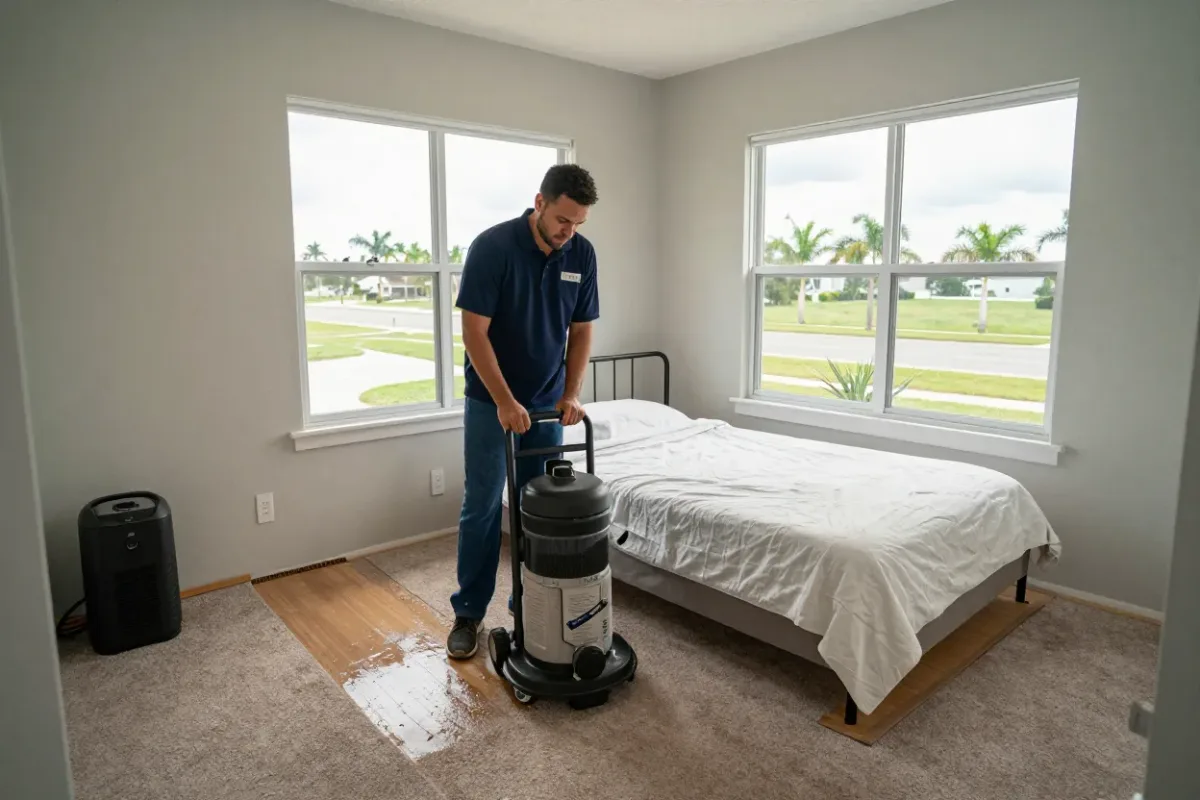
The fast emergencies are the ordinary ones: a water heater or washing machine hose failing overnight in a subdivision home, a roof leak during a summer storm, an air handler overflowing in the attic. Our crews arrive with pumps, extractors, air movers and dehumidifiers and begin the same visit, and they photograph and meter everything on arrival so your insurance record starts on the first day.
Restoring St. Cloud Homes From Wet to Finished
Restoration is the full path back to a dry, finished home, and the decisions along the way depend on moisture mapping. After extraction we meter every wall, floor and cabinet run the water could have reached, use thermal imaging to find moisture that has moved out of sight, and decide what can be dried in place and what must be removed. St. Cloud's housing is a mix of an older grid near downtown and the lakefront and many newer subdivisions and master-planned communities on the east and south sides, so the answer ranges from original wood floors that deserve a rescue attempt to builder-grade laminate that is quicker to replace than to save.
Drying is done with the home closed and the air conditioning on, dehumidifiers matched to the space and air movers aimed into cavities and under flooring edges. Readings are logged daily until each material reaches its dry standard; only then do cleaning, any antimicrobial treatment and the rebuild begin.
Flood Cleanup After East Lake Toho Overflows
Ian made St. Cloud, alongside Kissimmee, one of the worst-flooded parts of Osceola County. Lake water that sits in a home for days behaves differently from a pipe leak: it saturates the slab, wicks high into the walls, carries silt and contamination into every porous material, and gives microbial growth a running start before cleanup can begin. The November 2023 extreme single-day rainfall that caused flash flooding near the city along the Kissimmee River system showed that a tropical system is not required; a stalled rain event over flat ground can do it too.
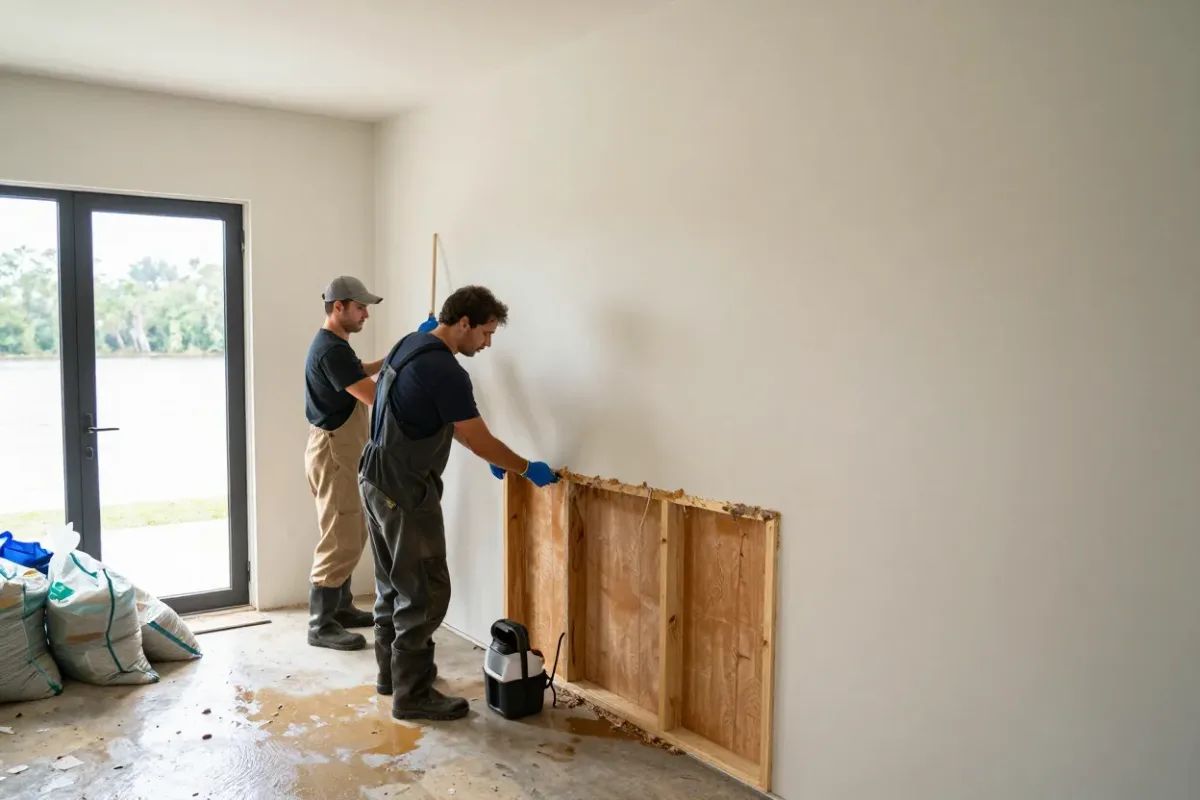
Lake and street water is treated as contaminated. Our flood cleanup crews remove the saturated drywall, insulation, carpet and pad rather than trying to dry them, clean and disinfect the hard surfaces that stay, and run HEPA filtration through the work. Homes on the lower ground near the lake and along Blackberry Creek get the closest inspection, along with mobile-home communities where floor systems sit close to grade. If floodwater is inside now, stay out of it and call; we can tell you what is safe to do while the crew is on the way.
Water Damage Repair and Rebuild
Repair begins when the moisture logs confirm the structure is dry, and not before. Typical St. Cloud work includes replacing the lower drywall and baseboard, reinstalling or replacing flooring, rehanging cabinets, repainting, and rebuilding ceilings below a roof or attic leak. In the older homes near downtown we work to match trim and floor materials; in the newer communities to the east and south the goal is a repair that blends with the builder's finishes.
St. Cloud also has mobile-home communities, and those suffered heavy damage in Hurricane Irma in 2017. Manufactured homes call for a different repair approach, with belly board, underfloor insulation and particleboard subfloors that behave differently from site-built construction. Whatever the building, the repair scope stays tied to the mitigation photographs and moisture maps so your adjuster sees exactly what the water reached.
Mold Removal in St. Cloud
Warm, humid conditions mean that any moisture left in a wall cavity or under a floor in St. Cloud can support visible growth within days. After lake flooding it is the lowest foot of every wall the water reached; after ordinary leaks it is the drywall behind tub surrounds, the back of kitchen base cabinets, the closet next to an air handler with a clogged condensate line, and the ceiling below an upstairs bathroom.
We fix the moisture source first, contain the area with sheeting and negative air, remove and bag the affected porous materials, HEPA-vacuum and clean the surfaces that remain, and confirm the space is dry before it is rebuilt. Painting over growth is not a repair. Our mold remediation page explains the method, and this guide to hidden mold covers where it tends to form after a loss.
Why St. Cloud Homes Take On Water
A very large lake, flat terrain, fast growth and a stock of both older and manufactured homes give St. Cloud a particular set of water damage sources. The ones we see most often are:
- East Lake Toho rising for days after a major storm and reaching low-lying streets and homes near the shore and along Blackberry Creek
- Extreme single-day rainfall, as in November 2023, overwhelming drainage on flat ground
- Water heater, washing machine and supply-line failures in the city's many newer subdivision homes
- Roof and flashing damage from hurricane winds, which every county school felt from Charley in 2004 and mobile-home communities felt from Irma in 2017
- Air conditioning condensate overflows in attics during the long cooling season
- Wind-driven rain forced through windows, sliding doors and lanai enclosures during tropical systems
- Slow pipe leaks inside walls and under slabs in the older grid of homes near downtown
- Water intrusion through skirting and underfloor areas of manufactured homes on low lots
Our Process, One Step at a Time
Every St. Cloud job follows eight stages in the same order, because the verification steps are what keep a rebuilt wall from becoming a second claim.
- InspectionWe confirm the source, classify the water, and meter every wall, floor and cabinet it could have reached, including slab edges where lake water wicks in from outside.
- Water removalPumps and extractors clear standing water from floors, lanais, garages and carpet and pad.
- Tear-out of ruined materialsSaturated drywall, insulation, swollen baseboard and delaminated flooring are cut out and bagged, which is nearly always required after lake water.
- Structural dryingAir movers and dehumidifiers run in the closed home with readings logged daily until each material reaches its dry standard.
- CleaningHard surfaces touched by contaminated water are cleaned and disinfected, with HEPA filtration running throughout.
- DocumentationPhotographs, moisture logs and a written scope are gathered for you and your insurance carrier.
- RepairDrywall, trim, flooring, cabinets and paint go back in to match the rest of the house.
- Final verificationA last round of moisture readings and a walkthrough confirm the home is dry and ready.
St. Cloud Areas We Serve
We respond throughout St. Cloud, from the downtown grid and the lakefront to the newest communities spreading east toward Narcoossee and Harmony. Our crews carry equipment suited to an older lakefront home, a manufactured home, or a two-story house finished last year.
St. Cloud Neighborhoods
- Downtown St. Cloud
- Blackberry Creek
- Pemberly Pines
- Summer Cove
- Sugar Mill
- St. Cloud Village
- Soleil Blue
- Jade Isle
- Savannah Park
- Canoe Creek
- Anthem Park
- Kissimmee Park
- Deer Creek
- Pine Lake Estates
Nearby Communities
The same lake system runs through the communities around St. Cloud, and our crews cover them as well. Several have their own local pages:
If Water Is in Your Home Right Now
Most homeowners can do these safely, and they limit the damage before our crew arrives. Nothing here should put you near water and electricity at the same time.
- Stop a plumbing sourceClose the valve at the fixture or the main. If the water is from the lake or a storm, there is nothing to shut off; move to the next step.
- Stay out of water that could be liveDo not enter a flooded room where outlets, cords or the panel may be wet. Turn off power to the area only from a dry panel you can reach without stepping in water.
- Treat lake and street water as contaminatedKeep children and pets clear of it and leave that cleanup to a crew with protective equipment.
- Get belongings off the floorMove electronics, documents and rugs to a dry room and raise furniture on blocks or foil.
- Photograph and video firstRecord the source, the waterline and each affected room and item before anything is disturbed.
- Leave the AC onCool, dry indoor air slows growth while you wait; keep the windows shut.
- Call Water Damage FloridaReach us at (888) 435-4769 and tell us the source, how long it has been wet, and whether the water is still rising.
If the lake is the source, our first 24 hours after a flood guide and the hurricane water damage recovery guide walk through the days ahead.
St. Cloud Water Damage Questions
The city issued a voluntary evacuation for my area but the water has not reached my house yet. Should I call now?
Yes. The best time to call is before the water arrives. We can help you move belongings up and out, stage equipment nearby, and be ready to extract and start drying the moment the lake begins to fall, rather than days later.
My street along Blackberry Creek flooded in Ian. Will the water come in the same way again?
We cannot predict the lake, but water generally follows the same low points it found before. When we restore a home that has flooded once, we note where it entered and how high it reached, and we discuss repair materials on the ground floor that tolerate another event.
Do you work on mobile and manufactured homes in St. Cloud?
Yes. Manufactured homes are part of the Osceola County housing mix, and their floor systems, skirting and underfloor insulation need a different drying approach from a slab home. Our crews are equipped for that work.
How long will the drying equipment be in my home?
Until daily readings show every material at its dry standard. That depends on how much water there was and how long it sat; we do not run equipment for a fixed number of days.
Do you handle the insurance paperwork?
The claim stays yours. We provide the photographs, moisture logs and written scope that show where the water came from, what it reached and what was done, so your adjuster has a clear record to work from.