Palm Coast was drawn on paper before it was built: a master-planned city in Flagler County, laid out by ITT in the late 1960s and 1970s as tens of thousands of home sites organized into lettered sections, with dozens of miles of freshwater and saltwater canals threaded through the plan. The Intracoastal Waterway forms the city's eastern edge, with the Hammock barrier island and the Atlantic beyond, and to the west the land runs low and flat into pine and palmetto. That layout gives Palm Coast two distinct water damage profiles: saltwater-canal neighborhoods exposed to storm surge off the Intracoastal, and inland sections where the problems are rain, drainage and plumbing. Water Damage Florida provides 24/7 water damage restoration across every section of the city.
The housing is overwhelmingly single-family homes on ITT-platted lots built from the 1970s onward, joined by newer gated and golf communities such as Grand Haven, Palm Coast Plantation and The Conservatory. Most are slab-on-grade with block or frame walls, which means the vulnerable materials are drywall, cabinets and flooring rather than the structure itself. Call (888) 435-4769 at any hour and tell us which section you are in; we will get a crew moving.
Emergency Water Damage Response in Palm Coast
Palm Coast emergency calls tend to cluster by section. From the saltwater-canal streets of Palm Harbor in the C and F Sections, the storm-season calls are about surge coming up over seawalls and into lanais and garages. From the inland sections such as Pine Lakes, Indian Trails, Seminole Woods and Lehigh Woods, the calls are year-round and domestic: a water heater in the garage, a washing machine hose, a slab leak found when the tile went cold and damp, a roof that opened up during a tropical downpour. Retirement-oriented neighborhoods add a particular wrinkle: leaks in homes that sit empty part of the year.
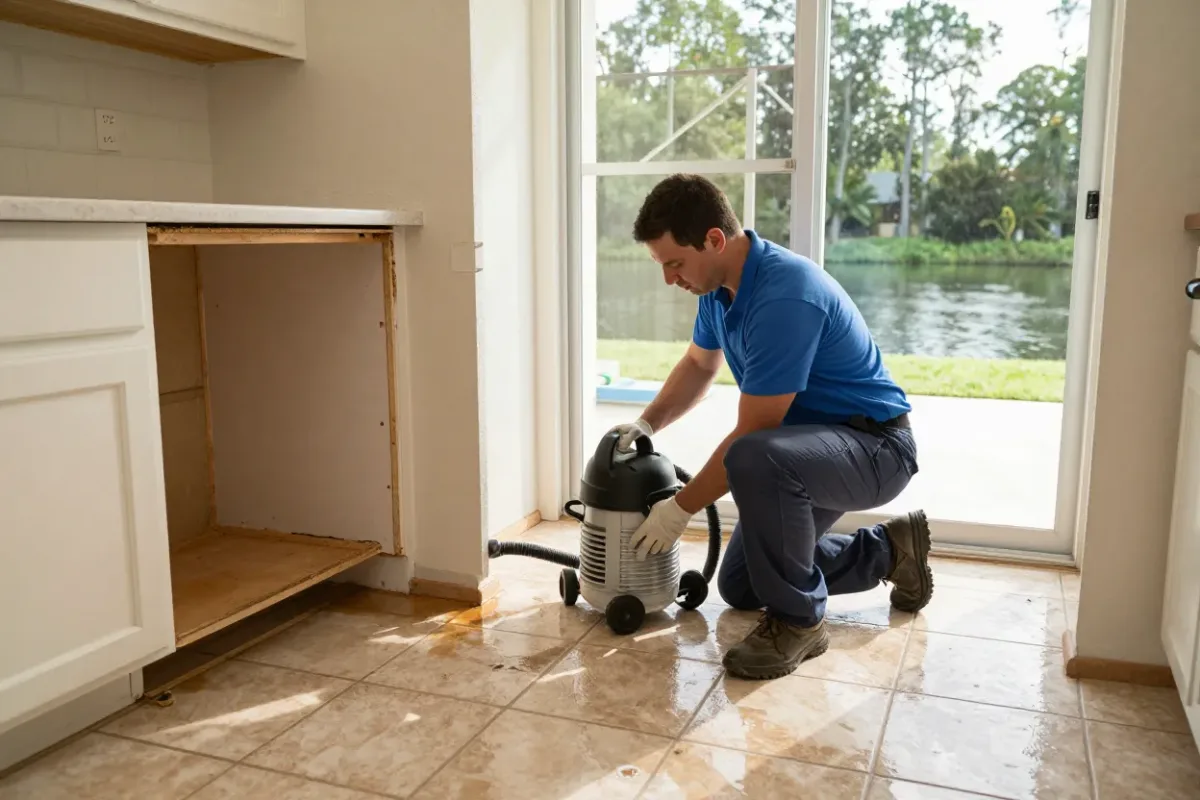
We arrive with pumps for garages and lanais, extractors for interior floors, and air movers and dehumidifiers to start drying on the first visit. In canal neighborhoods we bring rinsing equipment for salt residue. Moisture readings and photographs begin immediately so your claim starts with a clear record. What we need to know on the first call is covered on our emergency water damage page.
Restoration for ITT-Era Homes and Newer Gated Communities
Most Palm Coast houses share the same anatomy: a slab floor, block or frame exterior walls, drywall, and a screened lanai out back. Water damage restoration in that kind of home is mostly about the first two feet above the floor, where drywall, baseboards, cabinet toe-kicks, laminate planks and carpet pad soak up whatever reaches them. We map every wet material with moisture meters and thermal imaging, dry in place what the readings say can be dried, and remove only what cannot. In newer homes in Grand Haven or The Conservatory the finishes are more expensive but the approach is the same.
Drying is done with the house closed and dehumidifiers sized to the space, since the coastal humidity between the Intracoastal and the pine flats slows evaporation. Daily readings decide when it is finished, not the calendar. Cleaning, treatment where the water category calls for it, and rebuild follow.
Canal Surge and Storm Flood Cleanup
Palm Coast's flood history is a hurricane list. The area feels a tropical storm or hurricane every few years: Hurricane Floyd in 1999, Hurricane Charley and Hurricane Jeanne in 2004, Tropical Storm Fay in 2008, Hurricane Matthew in 2016, Hurricane Irma in 2017, and Hurricane Ian and Hurricane Nicole in 2022. Matthew is the benchmark for the canal neighborhoods: the Palm Coast saltwater canal measured surge depth of about six feet and parts of A1A washed out nearby, and a mobile home park near Flagler Beach lost roughly 200 homes to damage. Nicole collapsed a section of A1A in the county for a second time after Ian eroded the dunes. Hurricane Milton in 2024 dumped several inches of rain across Flagler County, with overwash on A1A and a swift-water rescue of a family stranded in floodwaters in Palm Coast.
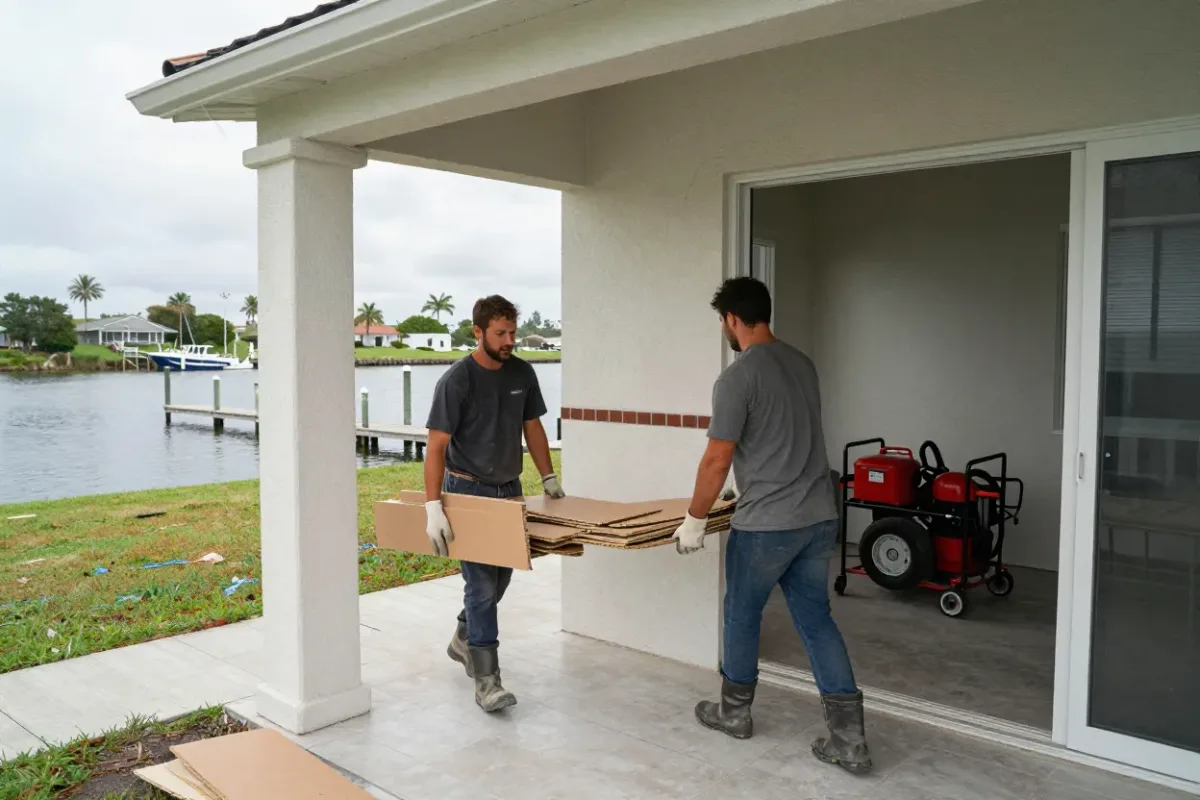
Canal, Intracoastal and street water is treated as contaminated, and saltwater canal surge adds corrosion. Flood cleanup means pumping out what remains, removing saturated porous materials rather than drying them, rinsing salt from block and slab, cleaning and disinfecting hard surfaces, and running air filtration while the house dries. Lanais, garages, and the rooms that open onto them get the closest look, because that is how surge enters a canal home.
Repair Once the Readings Say Dry
Repair in Palm Coast is mostly about restoring the lower part of the house: new drywall and baseboards, reinstalled or replaced flooring, rehung or replaced base cabinets, and fresh paint. In canal homes we also address sliders, exterior doors and lanai finishes that took salt water. In older ITT-era houses the work sometimes uncovers original materials worth matching, and in gated communities we follow HOA rules on hours and contractor access so the project does not stall.
We build the repair scope from the moisture logs and photographs taken during mitigation, so your adjuster sees a clear line between what the water damaged and what was there before. Seasonal residents can approve the scope remotely and receive progress photos and a video walkthrough at the end.
Mold Removal in Palm Coast Homes
Mold in Palm Coast usually traces back to a leak that went unnoticed for a while: the back of a bathroom wall in a Cypress Knoll ranch, an air handler closet in a Belle Terre home, a garage wall that took canal water and was never opened up, or a whole house in Pine Grove where a supply line failed while the owners were away for the summer. In warm months growth on wet drywall can start within days.
Our mold remediation begins with the leak, not the stain: fix the source, seal the room with sheeting and negative air, bag out the affected porous materials, HEPA-vacuum and clean what stays, and dry everything before the wall is closed. We do not fog a room and leave. If a wall in your home was once wet and simply dried on its own, read about where hidden mold forms after water damage before painting over it.
Where Palm Coast Water Damage Comes From
The causes differ between the canal sections and the inland sections, but across the city the most common ones we see include:
- Storm surge from the Intracoastal Waterway into saltwater-canal homes through lanais, garages and sliders
- Heavy tropical rainfall overwhelming drainage in the low, flat inland sections
- Water heater, supply line and appliance hose failures in single-family homes
- Leaks that run for weeks in homes left empty by seasonal residents
- Roof and flashing damage from hurricane and tropical storm winds
- Overflowing AC drain pans and blocked condensate lines, a warm-season staple of local water damage calls
- Slab and under-slab plumbing leaks in homes from the 1970s and 1980s
- Freshwater canal levels rising into low back yards and lanais after prolonged rain
Our Process, Section by Section
Whether the job is a slab leak in the W Section or surge in the F Section, the sequence is the same. Skipping the checks in the middle is how a new wall ends up wet a month later.
- Inspection and moisture mappingWe find the source, classify the water as clean, gray or salt, and trace how far it spread with meters and thermal imaging, including cabinets, closets and the garage.
- ExtractionPumps clear garages and lanais; portable extractors remove water from tile, laminate, carpet and pad inside.
- Removal of ruined materialsSoaked drywall, insulation, carpet pad and swollen cabinet bottoms are cut out and bagged so air can reach the slab and studs.
- Drying and dehumidificationAir movers and dehumidifiers run in the closed house, with readings logged daily until every material meets its dry standard.
- Cleaning and, for canal surge, salt rinseSurfaces touched by contaminated or salt water are rinsed, cleaned and treated, with air filtration running throughout.
- DocumentationPhotos, the drying log and a written scope go into a single package for you and your adjuster.
- RepairDrywall, baseboards, flooring, cabinets, doors and paint are rebuilt to match the rest of the house.
- Final moisture checkA final round of readings and a walkthrough, in person or by video, confirm the job is complete.
Palm Coast Sections and Neighborhoods We Serve
We cover every lettered section and gated community in the city, from the saltwater-canal streets of Palm Harbor along the Intracoastal to the inland sections toward the pine flats and the golf communities in between.
Palm Coast Neighborhoods
- Palm Harbor (C and F Sections)
- Indian Trails (B Section)
- Pine Lakes (W Section)
- Matanzas Woods (L Section)
- Cypress Knoll (E Section)
- Belle Terre (P Section)
- Pine Grove (P Section)
- Lehigh Woods (R Section)
- Seminole Woods (S and U Sections)
- Quail Hollow (K, LL and Z Sections)
- Woodlands (BL Section)
- Grand Haven
- Palm Coast Plantation
- The Conservatory
Nearby Communities
Our crews also cover the rest of Flagler County, the Hammock and the beaches, and the cities north and south along the coast. Several nearby cities have their own pages:
What to Do Right Away
You can do all of this safely without wading into water, and it will shorten the drying job when our crew gets there.
- Shut off the waterClose the valve at the fixture or appliance, or the main shutoff, if the source is plumbing. If you are away, ask a neighbor or property manager to do it.
- Stay out of water near electricityDo not enter a flooded garage or lanai room if outlets, cords, pool equipment or the panel could be in contact with water. Cut power at the panel only if the panel itself is dry and you can stand on dry floor to reach it.
- Treat canal and street water as contaminatedKeep children and pets out, avoid skin contact, and do not run household fans over it.
- Lift what you canMove rugs, electronics and furniture off wet floors; put foil or blocks under pieces that must stay.
- Photograph before cleaningCapture the source, the water line and each room before anything is moved or discarded.
- Keep the house cooled and closedRun the air conditioning and keep sliders and windows shut so humid air does not slow drying.
- Call with your sectionReach (888) 435-4769 and tell us the source, how long it has been wet, and which section or community you are in.
For storm situations, our hurricane water damage recovery guide and the first 24 hours after a flood checklist cover the next steps.
Palm Coast Water Damage FAQs
My home is on a saltwater canal. What should I expect if surge comes in?
Salt water is contaminated and corrosive, so drywall, cabinets and flooring it touched are removed, block and slab are rinsed before drying, and sliders, doors, appliances and electrical it reached should be inspected. Lanais and garages usually take the worst of it.
Is a house in an inland section really at risk for flooding?
Surge is unlikely, but the inland sections are low and flat, and heavy tropical rain can overwhelm drainage and freshwater canal levels. Plumbing failures do not care about geography at all, and they are the most common loss we see there.
We are seasonal residents. Can you handle a leak while we are away?
Yes. We work with a neighbor, property manager or your HOA for access, send photos, moisture logs and the scope for your approval, and close with a video walkthrough.
Can the original tile in an older ITT-era home be saved?
Hard flooring on a slab usually survives if the water was clean and it is dried and cleaned promptly. Laminate, carpet and wood flooring over it generally do not. We tell you after the moisture mapping.
How long does drying take in Palm Coast?
A clean-water leak in a slab home usually needs a few days of closed-house drying. Surge-flooded canal homes take longer because removal and rinsing come first. We estimate the schedule after the moisture survey and update it as the readings move.
Do you serve Flagler Beach and the Hammock too?
We do. Flagler Beach, the Hammock, Beverly Beach, Marineland and Bunnell are all part of our regular coverage, along with the rest of Florida through our statewide service areas.